

Shade Fabric for Large Format Motorised Systems - What Changes at Scale
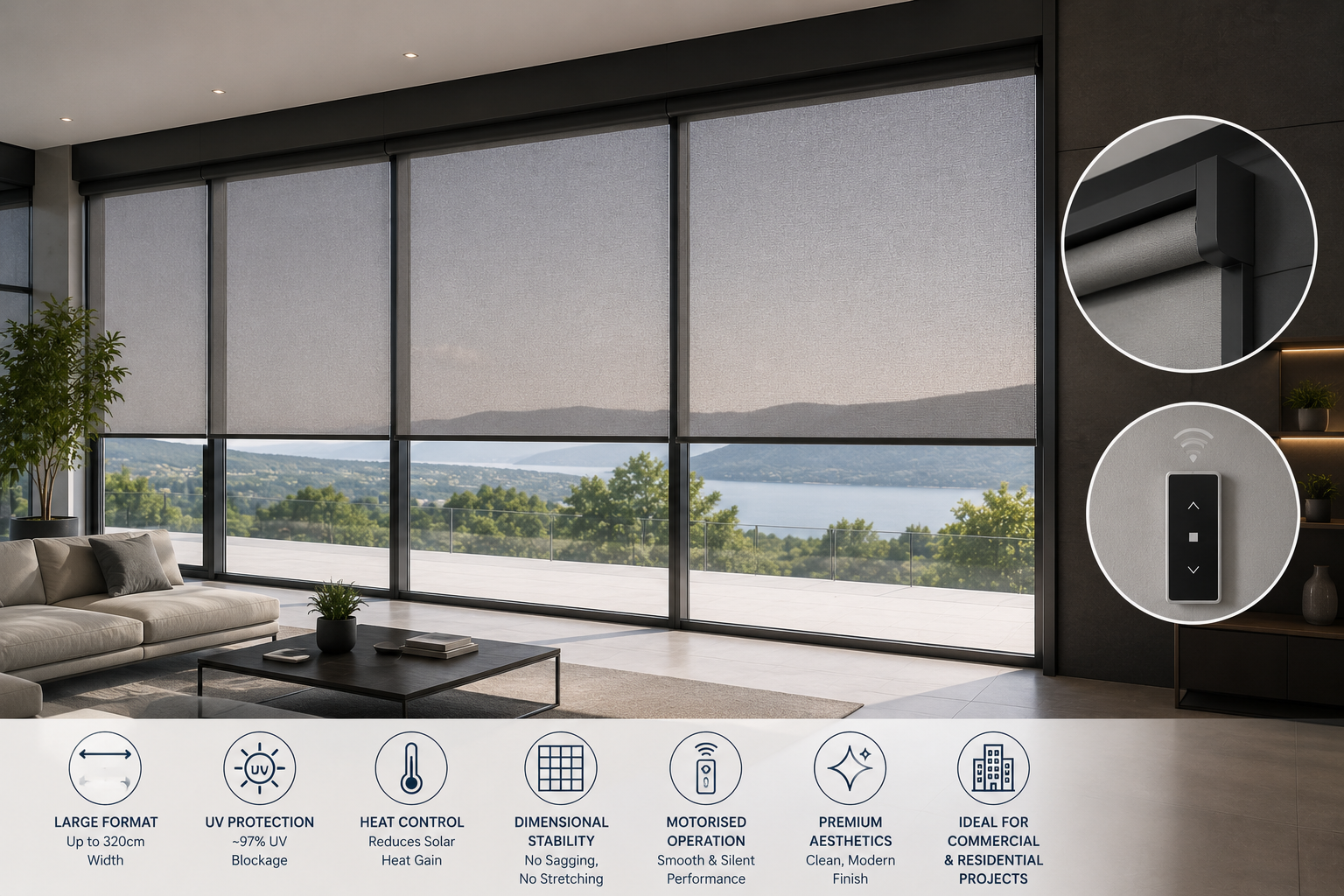
There is a version of shade fabric specification that works perfectly well for a standard 1.2 metre roller blind in a domestic bedroom. And then there is the version that needs to work for a 3.5 metre wide motorised zip-screen on a hotel facade, repeated across 180 guest rooms. These are not the same specification exercise, and treating them as if they were is one of the more reliable ways to create a project that underperforms from day one and dete riorates progressively from there.
This article is for blind manufacturers, facade engineers and project specifiers who are working with large format motorised systems. It covers the specific ways that scale changes the fabric specification requirements and what to prioritize when the stakes are high.
Where Scale Changes Everything
Most of the technical requirements for shade fabric UV blockage, fire certification, solar performance are scale neutral. A fabric either meets the fire standard or it does not, regardless of whether it is in a 1 metre or 4 metre system.
Dimensional stability is not scale neutral. This is the property that determines whether a large format motorised system operates correctly over time, and it is where the specification decision has the most significant real world consequences.
In a zip-guided motorised system, the fabric edges run within aluminium channels. The motor drives the fabric up and down within those channels on every operation cycle. For this to work reliably, the fabric needs to be the same width at the top of the run as it is at the bottom, at -5°C in January as it is at +55°C on a south-facing facade in August.
Polyester yarn the core of PVC/poly shade fabrics expands and contracts measurably with temperature. The coefficient of thermal expansion of polyester is approximately five times that of glass fiber. On a 3 metre wide panel across a 60 degree temperature swing, this represents several millimetres of width change. In a residential roller blind with no side guidance, several millimetres is invisible. In a zip-guided system with tolerances measured in fractions of a millimetre, it is a tracking failure in waiting.
Glass fiber has near-zero thermal expansion. This is the engineering reason why fiberglass core shade fabric is the correct specification for large-format motorised systems not marketing language, not preference, but the physical property that makes the system work correctly year after year.
Roll Diameter and Cassette Design
The second dimension where scale matters is roll diameter. As fabric accumulates on the roller tube with each retraction, the effective diameter of the roll increases. At full retraction, the diameter of the roll determines whether the fabric fits within the specified cassette housing.
On a short blind with a small amount of fabric, the change in roll diameter from fully extended to fully retracted is small. On a large format blind with a long drop a 3 metre drop requires three times the fabric of a 1 metre drop the accumulated roll is significantly larger. If the cassette depth has not been specified to accommodate this, the fabric jams against the cassette housing on retraction. This is not an installation error. It is a specification error that manifests at installation.
The relevant data from the fabric supplier is fabric thickness in millimetres and roll diameter per metre of fabric at a given tube diameter. From these two numbers, the required cassette depth for any combination of tube diameter, fabric thickness and drop length can be calculated. For large-format systems, this calculation should be done before the cassette is specified, not after.
Fiberglass shade fabrics are typically 0.70 to 0.75mm thick. PVC/poly fabrics vary more widely from approximately 0.45mm to 0.65mm depending on the product. The thinner PVC/poly fabric produces a smaller roll diameter for the same drop length, which is relevant where cassette space is limited. However, for systems where dimensional stability is the critical requirement, the slightly larger roll diameter of fiberglass fabric is the acceptable trade-off for the tracking performance it delivers.
Seam Placement in Wide Panels
Standard roll widths for high performance technical shade fabrics range from 250cm to 320cm. For panels wider than the maximum roll width, a seam joining two widths of fabric is unavoidable. How that seam is specified and positioned has both structural and aesthetic consequences.
Structurally, the seam is a change in fabric thickness and stiffness. In a motorised roller system, this creates a slight variation in roll diameter at the seam location, which can produce a visible line on the accumulated roll or, in more severe cases, cause uneven roll formation that affects system operation over time. The welded or glued joint must be strong enough to withstand the tension loads of the system across thousands of cycles without delamination.
Aesthetically, a seam is visible from the interior as a vertical line in the fabric panel. For most commercial applications this is acceptable; for premium hospitality interiors where the fabric is a visible design element, the seam position becomes a design consideration. Placing the seam off-center or at a position that aligns with a structural element of the facade can minimize its visual impact.
The practical approach for projects with panels wider than available roll widths is to specify the maximum roll width first choosing a fabric available at 320cm allows more installations to avoid seaming entirely and address seam specification explicitly for any panels that still require joining.
TepText's fiberglass sunscreen and blackout fabrics are available at 250cm, 300cm and 320cm widths. For single panels up to 320cm, seamless specification is achievable.
Motor Torque and Fabric Weight
Large format fabrics are heavier, and heavier fabrics require more torque from the motor to operate. This seems obvious, but the interaction between fabric weight, panel dimensions and motor specification is a calculation that should happen before the motor is ordered, not after.
The relevant fabric data is weight per square metre, expressed in g/m². Fiberglass shade fabrics typically weigh 540 to 560 g/m². A 3 metre wide by 3 metre drop fiberglass panel at 550 g/m² weighs approximately 5kg of fabric alone. The motor torque specification must account for this fabric weight plus the weight of the hem bar, plus any friction in the system at minimum.
Undersized motors are one of the most common causes of large format motorised system underperformance. An undersized motor may operate the system successfully when new, but as the system ages and friction increases slightly from wear, the motor no longer has the reserve torque to operate reliably. Regular nuisance failures, inconsistent retraction and eventual motor burnout are the progressive consequences.
For any large-format system, share the fabric weight specification with the motor supplier and have the motor selection confirmed against that data rather than estimated from general experience.
Wind Load and Structural Considerations
External large format motorised systems are exposed to wind loads that do not apply to interior blinds. At full extension on a south facing facade in a coastal or elevated location, a 3-metre wide by 3 metre drop fiberglass sunscreen panel presents a substantial surface area to wind pressure.
Most manufacturers of motorised zip screen systems specify a maximum wind speed for extended operation and require the system to be retracted above that threshold. This is a system design consideration, not a fabric one the wind resistance of the system is determined by the structural frame, the zip channel design and the anchoring, not the fabric alone.
However, fabric weight, thickness and the tension it can withstand without distortion are relevant to the wind load calculation. The structural engineer or system manufacturer needs these fabric parameters as inputs to the wind load analysis. Providing fabric weight in g/m² and tensile strength data per the fabric specification is a normal part of the technical package for a large format exterior system.
For exposed locations where extreme wind events are possible, the specification should include not just the operational wind speed limit but the protocol for when retraction is triggered whether manually, through a wind sensor, or through the building management system. The best fabric specification in the world does not protect a system that is left deployed in conditions beyond its design parameters.
Control Systems and Large Format Fabric
The control system for a large-format motorised installation affects fabric performance in ways that are not always considered at specification stage.
End limits the preset stop points that tell the motor where fully extended and fully retracted positions are need to be set with precision for large format systems. If the fully retracted limit is set too high, the fabric overwinds on the tube, progressively compressing the accumulated roll and eventually causing roll formation problems. If the fully extended limit is set too low, the hem bar does not reach the sill, leaving a light gap that compromises the system's shading performance.
For fiberglass fabric in particular, the end limit calibration should account for any variation in roll diameter that occurs over the first few operational cycles as the fabric settles onto the tube. Setting limits after the first ten or twenty cycles rather than immediately after installation produces a more stable long term calibration.
For large-format systems integrated with building management or sun-tracking control, the operational logic how often the system deploys and retracts in response to solar position data affects the cumulative cycle count on both the fabric and the motor. High-frequency cycling driven by sun-tracking algorithms in partly cloudy conditions can rapidly accumulate cycle counts that exceed what was assumed in the system's maintenance planning. This is worth addressing in the control system programming rather than discovering it as premature wear after two years of operation.
Source Premium Performance Fabrics for Your Projects
Get custom B2B quotes and technical data for our high-quality Sunscreen (PVC & Fiberglass), Blackout, Silverscreen, and Mesh fabric series tailored for commercial and architectural projects.
Large Format Specification in Practice
Pulling this together into a practical specification framework:
Specify fiberglass core fabric for any motorised zip guided system regardless of span, and for any unguided motorised system with a span greater than approximately 2 metres where dimensional consistency under thermal variation is a system performance requirement.
Calculate cassette depth requirements from fabric thickness and drop length before specifying the cassette. Do not assume standard cassette dimensions are adequate for large drops.
Specify seam position explicitly for panels wider than the maximum available roll width. For premium projects, choose a fabric available at 320cm to maximize the number of panels that can be specified without seaming.
Confirm motor torque specification against fabric weight per square metre multiplied by panel area, plus hardware weight and a reasonable friction margin.
Provide fabric technical data weight, thickness, tensile strength to the structural engineer or system manufacturer for any externally mounted system in a location with significant wind exposure.
Set end limits after the fabric has been cycled ten to twenty times rather than immediately after installation.
TepText's fiberglass sunscreen and blackout fabrics are available in widths up to 320cm with full technical data provided for system specification. For project specification support or technical data requests, contact the team at info@teptext.com.
