

The Role of Technical Textiles in Net Zero Building Design
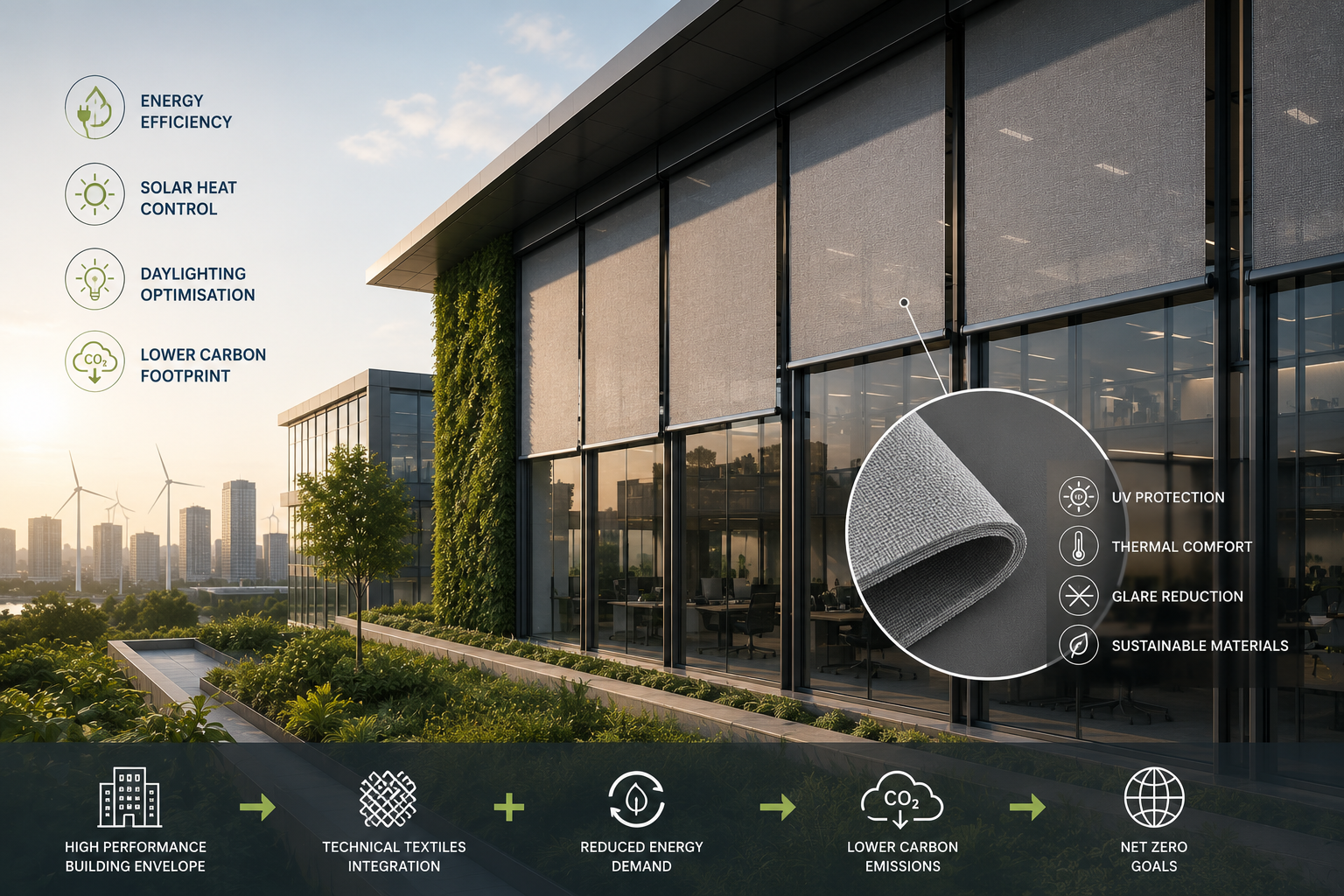
Net zero carbon is reshaping how buildings are designed, engineered and specified. What was a niche ambition a decade ago is now a mainstream requirement embedded in planning policy in many jurisdictions, expected by institutional investors, and increasingly demanded by the occupiers and operators who will use the buildings for the next thirty or forty years.
Most net zero conversations focus on the big-ticket items: structure, glazing systems, mechanical plant, renewable energy. The contribution of facade shading and technical textiles to the net zero equation tends to be treated as marginal, or overlooked entirely. This is a mistake not because shade fabric changes the fundamental energy equation on its own, but because solar control at the facade is one of the most cost effective interventions available for reducing cooling demand, and cooling demand is often the dominant energy load in commercial buildings in warming climates.
This article looks at where technical textile shading fits in the net zero building picture the real numbers, the design integration questions, and what good specification actually looks like in this context.
Why Cooling Load Is Central to the Net Zero Challenge
The drive toward net zero has revealed an uncomfortable reality about contemporary commercial architecture: glass-dominated facades that read as sophisticated and transparent from the street can be profoundly energy-inefficient on their interior faces. Large areas of high performance glazing still transmit significant solar heat, and the cooling systems required to manage that heat in summer are among the most energy intensive elements of a commercial building.
In hot and warm temperate climates, cooling energy can account for 30 to 50 percent of a building's total operational energy consumption. In warm climate office buildings with south and west facing glazing, that proportion can be even higher. Reducing cooling demand is therefore not a minor refinement to the net zero strategy it is often central to it.
Solar control at the facade is the most direct intervention available. Before solar radiation becomes heat inside a building, it can be intercepted reflected back to the exterior, absorbed in the facade layer and dissipated outward, or modulated to allow daylight while reducing heat. Technical shade fabrics do all three, and their effectiveness depends heavily on where they are positioned relative to the glazing and what solar performance values the fabric delivers.
The Physics of Facade Solar Control
The position of a shade fabric relative to the glazing determines the physics of how it manages heat. This distinction matters enormously for net zero design, and it is underrepresented in most general discussions of window treatment specification.
An external shade fabric intercepts solar radiation before it reaches the glass. Energy reflected by the external fabric goes back to sky it never enters the building envelope. Energy absorbed by the fabric heats the fabric surface, which then loses heat to the exterior air by convection and to the sky by radiation. Even a fabric with moderate solar absorption performs well in an external position because the absorbed energy has a direct route out of the building rather than in.
An internal shade fabric operates after solar radiation has already passed through the glazing. Energy reflected by the internal fabric bounces back through the glass, but a significant proportion is absorbed in the glazing cavity before it can escape. Energy absorbed by the fabric is re-radiated directly into the interior space. The consequence is that internal shading, while better than no shading, is substantially less effective at managing solar heat gain than external shading of the same nominal specification.
The quantitative difference is significant. Studies comparing internal and external shading of the same solar transmittance specification consistently show that external shading reduces solar heat gain by substantially more than internal shading in some analyses by a factor of two or more in peak conditions. For a net zero building where every kilowatt-hour of cooling energy matters, this difference has real consequences for the energy model and the building's actual operational performance versus its design prediction.
This is one of the architectural arguments for investing in motorised external shading systems not just for the occupant comfort benefit, but for the energy performance benefit that makes external shading a rational net zero design decision rather than a premium aesthetic choice.
Daylighting and Artificial Lighting Energy
The cooling load equation is only one side of the energy picture. The other side is artificial lighting.
A building that controls solar gain by specifying very low visual transmittance fabrics heavy tints, very low openness factors may reduce cooling load but simultaneously increase the hours during which artificial lighting is required to compensate for lost natural light. Artificial lighting has its own energy cost, and in a tightly specified net zero building, that cost needs to be modeled alongside the cooling benefit.
This is the daylighting optimization challenge, and it is where the per-colorway visual transmittance data from shade fabric suppliers becomes genuinely useful in design. The goal is to find the specification that reduces solar heat gain sufficiently to lower cooling demand without reducing natural light to the point where artificial lighting energy consumption increases correspondingly.
The answer is not the same for every facade. A south facing office in a hot climate might tolerate a 5% visual transmittance fabric on the south elevation accepting the reduction in natural light because the cooling benefit of aggressive solar rejection is large while the same building's north elevation might specify a 20% visual transmittance fabric to maximize natural light on an elevation with minimal solar heat exposure. Treating the building as a single uniform specification misses this opportunity.
Motorised systems with sun tracking control add another dimension to this optimization. A system that deploys shading only when the sun is directly on the facade and retracts at other times maximizes natural light during non peak solar conditions while controlling heat gain during peak exposure. The fabric specification for such a system needs to deliver effective solar rejection when deployed; the system design handles the daylighting optimization through deployment logic rather than fabric transmittance.
Embodied Carbon and Material Choices
Net zero building design increasingly addresses embodied carbon as well as operational carbon the carbon emitted in manufacturing, transporting and installing building materials, not just in operating the building over its lifetime.
For shade fabric specification, embodied carbon considerations point in two directions. First, durability: a fabric that lasts fifteen years before replacement has lower embodied carbon per year of service than one that lasts five years. The higher quality technical textile has a smaller embodied carbon footprint on a lifecycle basis, even if its manufacturing process is more energy-intensive. This is the circular economy argument for specifying quality not the upfront cost, but the whole-life performance.
Second, material composition: PVC based fabrics have been subject to scrutiny in sustainable building specifications because PVC production involves chlorine chemistry and the end of life treatment of PVC raises recycling challenges. PVC free alternatives including 100% recyclable polyester fabrics without PVC coating are available for projects where material chemistry is a specific specification criterion. These alternatives may or may not match the solar performance, fire certification and dimensional stability of conventional technical shade fabrics depending on the specific product, and the comparison needs to be made on the full technical specification, not material type alone.
The sustainable credentials that are most straightforwardly useful in a LEED or BREEAM context are certifications like GREENGUARD Gold for low chemical emissions and declared recycled content. These are material and manufacturing process certifications that contribute to specific credit categories rather than the broader embodied carbon question, but they are the ones that a project's sustainability consultant will most directly be able to use.
The Adaptive Facade: Where Technical Textiles Fit
One of the defining architectural concepts in net zero building design is the adaptive facade a building skin that responds to environmental conditions dynamically rather than performing statically. Solar position, outdoor temperature, wind speed, occupancy, and grid electricity price can all be inputs to a facade that adjusts its behavior in real time.
Motorised shade fabric systems are the most widely deployed form of adaptive facade element. They are cost effective relative to electrochromic glazing or other dynamic glazing technologies, they are reversible and replaceable without structural intervention, and they perform reliably over the operational life of the building when correctly specified and maintained.
In this context, the fabric specification is the fixed component of an adaptive system the physical material whose properties determine the range of performance the system can deliver. A well-specified fiberglass sunscreen fabric at 5% openness with high solar reflectance, deployed and retracted in response to sun-tracking data, can deliver a significantly different energy outcome than the same fabric left in a fixed position. The fabric creates the performance ceiling; the control system determines how close to that ceiling the building operates in practice.
For net zero building projects where energy modeling is a formal deliverable, integrating the shade system's operating schedule and fabric solar performance data into the model rather than using generic assumptions about shading produces a more accurate prediction of actual operational performance. The gap between predicted and actual energy performance in commercial buildings is well-documented, and shade system operation is one of the variables that contributes to it.
Source Premium Performance Fabrics for Your Projects
Get custom B2B quotes and technical data for our high-quality Sunscreen (PVC & Fiberglass), Blackout, Silverscreen, and Mesh fabric series tailored for commercial and architectural projects.
A Specification Approach for Net Zero Projects
For project teams working on net zero certified buildings, the shade fabric specification process benefits from being treated as an integral part of the energy design rather than a finishes decision made late in the design program.
Start with the energy model. Understand which facades are driving cooling load, what solar heat gain assumptions are currently in the model, and how the shade specification affects those assumptions. A facade engineer or energy modeler who has worked with shade fabric solar performance data will be able to advise on the fabric transmittance values needed to achieve the modeled cooling load reduction.
Specify by facade orientation. South and west facades in cooling dominated climates need maximum solar rejection high Solar Reflectance colorways at 3% to 5% openness in external systems where feasible. North facades need less aggressive specification and benefit from higher visual transmittance to support daylighting.
Consider external systems where the design permits it. The energy performance benefit of external over internal shading is significant enough to justify the additional cost in most net zero building contexts, provided the building geometry and planning context allow external motorised systems to be incorporated.
Request per-colorway solar performance data from fabric suppliers and use it in the energy model rather than generic product-level values. The variation between colorways of the same fabric is real and meaningful at the level of precision that net zero energy modeling requires.
Verify durability credentials service life, UV stabilisation, fire certification to ensure the fabric specification maintains its performance over the building's operational life. A net zero building that achieves its energy targets in year one but requires fabric replacement in year six because the specification was under-specified has not delivered a net zero outcome on a lifecycle basis.
TepText supplies fiberglass sunscreen and blackout fabrics with full per-colorway solar performance documentation suitable for integration into energy models. For project specification support or technical data, contact the team at info@teptext.com or visit teptext.com/outdoor-fabrics.
