

Fire Retardant Fabric for Blinds - What M1 and NFPA 701
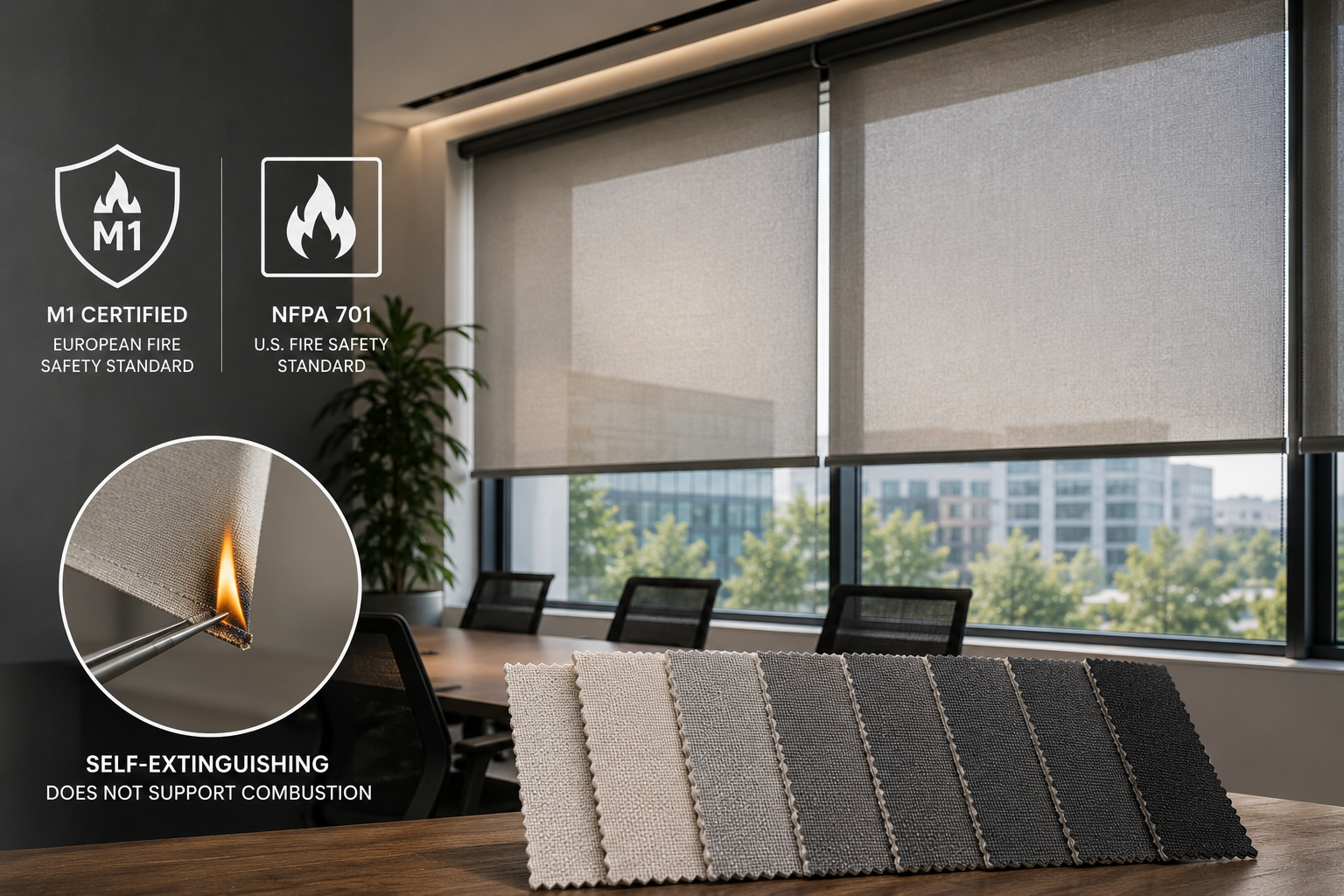
Fire certification is one of those specification requirements that nearly everyone treats as a checkbox. The product page says "fire certified," the box gets ticked, and the project moves on. This works fine until a project auditor, a building inspector or an insurance assessor asks for the actual test certificate at which point the difference between a product that is genuinely certified and one that is described as fire retardant becomes a very practical problem.
This article explains what M1 and NFPA 701 actually mean in terms of fabric behavior, how they differ from each other, what documentation you should be asking for, and why the distinction between fire certification and fire resistance matters more than most people realize when specifying shade fabric for commercial buildings.
What Fire Retardant Means for Fabric
A fire retardant fabric is one that has been engineered or treated so that it does not sustain combustion once the ignition source is removed. It may char, it may smolder briefly, but it will not continue to burn independently. This is the property that fire certification tests are designed to measure.
It is worth being clear about what fire retardant does not mean. It does not mean the fabric is fireproof no textile is fireproof in the sense of being unaffected by fire. It does not mean the fabric will not burn under sustained exposure to flame. It means that when the flame is removed, the fabric stops burning. In a real fire scenario, this property matters because it limits the contribution of the fabric to fire spread, giving occupants more time to evacuate and reducing the fire load in the building.
For PVC-coated technical shade fabrics like fiberglass sunscreen and polyester blackout, fire retardancy is achieved primarily through the formulation of the PVC coating itself. Flame-retardant additives incorporated into the PVC compound during manufacturing give the coating the self-extinguishing property. This is an inherent material property, not a surface treatment that can wear off over time which is one of the reasons high-quality PVC-coated shade fabrics maintain their fire performance throughout their service life.
The M1 Standard: What It Tests
M1 is a French fire classification defined under the NF P92-503 standard. Despite being a French national standard, it is widely referenced internationally particularly across European commercial building projects and in any project where European specifications are used as the reference framework.
The test places a fabric specimen in front of a radiant heat source and assesses its behavior across several criteria: ignitability, flame spread, heat release, and the production of burning droplets or particles. M1 is the highest classification for flexible materials under this standard. A fabric classified M1 is considered non flammable in the context of French building regulation meaning it will not contribute to fire spread in a way that endangers occupants or the building structure.
The M1 classification covers the full range of fire behavior that matters for interior and exterior shade fabric in commercial buildings. For European projects, M1 on a shade fabric is the reference certification that building regulators, fire engineers and specification consultants recognize. If someone asks whether a fabric is fire certified for a European commercial project and you cannot show an M1 certificate, the conversation tends to stop there.
NFPA 701: What It Tests
NFPA 701 is the U.S. National Fire Protection Association's standard for flame propagation of textiles and films. It is the most widely referenced fire standard for window treatments, curtains, draperies and shade fabrics in North American commercial buildings, and it is also referenced in international commercial projects particularly in hospitality, where global hotel brands often specify to U.S. standards regardless of the project's location.
The NFPA 701 test burns fabric specimens under defined conditions and measures flame spread, afterflame time and whether the fabric produces flaming drips or particles that could ignite secondary fires. A fabric that passes NFPA 701 does not sustain combustion the flame self-extinguishes after the ignition source is removed, and the fabric does not produce burning droplets.
There are two test methods within NFPA 701: Method 1 for lighter fabrics and Method 2 for heavier materials. For most shade fabrics in the weight range of commercial technical textiles 400 to 560 g/m² Method 2 applies. When a supplier references NFPA 701 compliance, confirming which method was used is a reasonable due diligence step.
M1 and NFPA 701 Together: Why Dual Certification Matters
M1 and NFPA 701 are not the same test. They measure similar properties using different methodologies, with different pass criteria and different reporting formats. A fabric can pass one and not the other, which is why dual certification is more meaningful than either standard alone.
For any commercial project that might be specified against both European and North American standards which describes most large hospitality projects, international real estate developments, and any project where the client operates across multiple markets a fabric that carries both M1 and NFPA 701 is the specification that covers the full range without requiring separate verification for different markets.
TepText's fiberglass sunscreen and fiberglass blackout fabrics carry both M1 and NFPA 701 certification. This dual certification is noted in the product documentation, and original test certificates are available on request for project specification files.
The Documentation Question
Here is where many specification processes fall short. A product page or a data sheet that describes a fabric as "M1 certified" or "NFPA 701 compliant" is a claim. A claim is not documentation.
In a formal project context, documentation means an original test certificate issued by an independent accredited laboratory, identifying the specific product and batch tested, the test standard and method applied, the test date, and the test results. This certificate needs to be traceable the laboratory should be identifiable and verifiable, and the tested product should correspond to the product being specified.
Why does this matter? In a building compliance audit, an insurance claim, or a post-incident investigation, the certificate is what matters. A product description is not evidence. A supplier who can provide original test certificates promptly is demonstrating a level of technical credibility that goes beyond marketing. A supplier who cannot, or who offers only informal documentation, is a specification risk regardless of how the product performs in normal use.
For any commercial, healthcare, educational or hospitality project where fire certification is part of the specification, request the certificates before finalizing the specification not after the order is placed.
What About Other Standards?
M1 and NFPA 701 are the most widely referenced standards for shade fabric in international commercial projects, but they are not the only ones. A brief overview of other standards that arise in specific contexts:
BS 5867 is the British Standard for curtains and drapes, referenced in UK commercial and healthcare projects. It defines performance levels A, B and C, with B being the most commonly specified for commercial window treatments. For projects specifying to UK building regulations, confirming BS 5867 compliance alongside or instead of M1 may be relevant depending on the specific application.
EN 13501 is the European classification system for the reaction of construction products to fire. Some European projects specify to EN 13501 rather than M1, and the classification levels A1, A2, B, C, D, E, F do not map directly onto M1. For projects where EN 13501 is specified, confirm whether the shade fabric supplier has test data under this standard specifically.
OEKO-TEX Standard 100 is sometimes raised in the context of fire certification but is a different type of certification entirely it addresses chemical safety and the absence of harmful substances in textiles, not fire performance. It is relevant for indoor air quality and materials certifications but should not be confused with fire certification.
Treatment-Based vs Inherent Fire Retardancy
One distinction worth understanding when evaluating fire retardant shade fabrics is whether the fire performance comes from an inherent material property or from a chemical treatment applied to the surface.
Surface treatments can provide fire retardancy but are vulnerable to washing, UV exposure and general wear over time. A fabric that passes a fire test when new but loses its fire retardancy after cleaning or UV degradation is not a reliable long-term specification.
PVC-coated technical shade fabrics achieve fire retardancy through additives incorporated into the PVC compound during manufacturing. This is an inherent material property, not a surface treatment. The fire performance of the fabric does not degrade over normal cleaning cycles or UV exposure, which is why high-quality fiberglass and PVC/poly shade fabrics from credible manufacturers maintain their M1 and NFPA 701 classification throughout their service life.
When evaluating fire certification claims for any shade fabric, it is worth asking explicitly whether the fire retardancy is inherent to the material formulation or applied as a surface treatment. The answer is relevant to how much confidence you can place in the certification holding up over the product's operational life.
Source Premium Performance Fabrics for Your Projects
Get custom B2B quotes and technical data for our high-quality Sunscreen (PVC & Fiberglass), Blackout, Silverscreen, and Mesh fabric series tailored for commercial and architectural projects.
Practical Summary for Specifiers
If you are specifying shade fabric for any commercial building, the fire certification process comes down to three questions.
What standard does the project require? Confirm with the fire engineer or building regulator which standard applies to the specific project jurisdiction and building type. Do not assume M1 is sufficient for a North American project, or that NFPA 701 covers a European specification.
Can the supplier provide original test certificates? Not a data sheet, not a product description the actual laboratory certificate. If the supplier cannot provide this, they cannot be used in a documented specification.
Is the fire retardancy inherent or applied? For long term reliability, inherent fire retardancy through material formulation is preferable to surface treatment, which degrades.
TepText's fiberglass sunscreen and blackout fabrics carry both M1 and NFPA 701 certification, with original test documentation available for project files. For certification documentation requests or project specification support, contact the team at info@teptext.com.
