

Solar Heat Gain Coefficient and Shade Fabric: What Every Architect Needs to Know
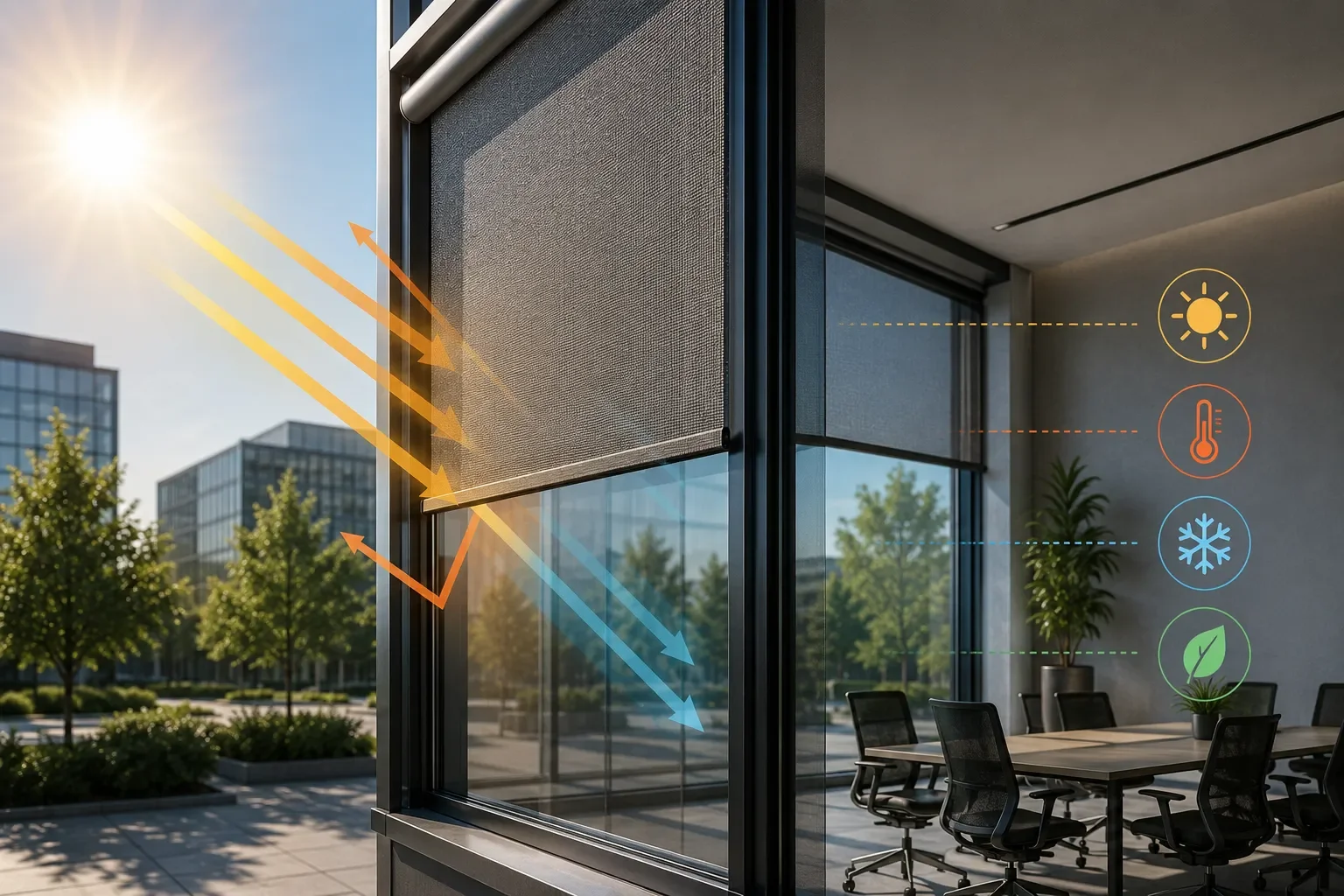
There is a gap that appears repeatedly in commercial building projects. The glazing specification is carefully engineered. The HVAC system is modeled against the expected thermal load. And then the shade fabric is chosen from a sample card based on color preference, with no reference to the solar performance data that would actually connect it to the rest of the building's energy strategy.
This article is for the architects and engineers who want to close that gap. It covers what Solar Heat Gain Coefficient means in practice, how shade fabric interacts with it, and what data you actually need to make a fabric specification that supports the building's performance objectives rather than undermining them.
What Solar Heat Gain Coefficient Actually Means
Solar Heat Gain Coefficient, universally referred to as SHGC, is the fraction of incident solar radiation that enters a building through a glazing assembly and becomes heat inside the space. It is expressed as a number between 0 and 1. A glazing assembly with an SHGC of 0.25 allows 25% of incident solar radiation to become interior heat gain; one with 0.60 allows 60%.
SHGC is not the same as visible light transmittance. A highly tinted glass might transmit relatively little visible light while still transmitting significant infrared radiation. Solar radiation spans ultraviolet, visible and near infrared wavelengths, and it is the combined package that determines heat gain not just the visible portion.
In hot climates and on high exposure facades, minimizing SHGC is a primary cooling load driver. In cold climates or on north-facing facades, a higher SHGC may actually be desirable to capture passive solar heat gain in winter. The appropriate SHGC target is always facade-specific and climate-specific.
Where Shade Fabric Enters the Calculation
A shade fabric specification changes the effective SHGC of the window assembly. This is the core of why fabric selection is a technical decision with energy consequences, not just an aesthetic one.
When a solar screen fabric is positioned at the glazing whether as an interior blind or an external motorised system it intercepts solar radiation before some or all of it passes through the glass and becomes interior heat. The fabric's own solar performance values determine how much interception occurs.
The relevant values are:
Solar Transmittance is the proportion of total solar radiation that passes through the fabric. A fabric with Solar Transmittance of 0.10 transmits 10% of incident solar energy. Combined with the glazing's own solar performance, this determines the total heat gain through the window assembly.
Solar Reflectance is the proportion of solar radiation reflected back outward by the fabric surface. For exterior shade systems, high Solar Reflectance is highly desirable because the reflected energy never enters the building envelope at all. For interior systems, the energy reflected back through the glass is still absorbed within the glazing cavity before re radiating inward, making Solar Reflectance less decisive in that context.
Solar Absorption is the proportion of solar radiation absorbed into the fabric itself. A dark fabric with high Solar Absorption becomes warm and re radiates heat into the adjacent space. For interior blind applications, high absorption in a dark fabric can partially negate the benefit of its low transmittance, because the absorbed energy is reradiated into the room.
The practical implication of all this is that fabric color is not a neutral aesthetic choice. On a south facing facade in summer, the difference in effective heat gain between a white and a charcoal fabric of identical openness factor can be significant. Specifying by color preference without reviewing Solar Absorption and Reflectance data is a gap in the technical process.
External vs Internal Shading: The Physics Are Different
Whether a shade fabric is installed externally or internally changes how the solar performance values translate into actual heat gain.
An external shade fabric intercepts solar radiation before it reaches the glass. Energy that is reflected by the fabric goes back to the sky. Energy that is absorbed heats the fabric itself, which then loses that heat to the exterior via convection and radiation to the sky not to the interior. Even a fabric with moderate absorption performs well as an external shade because absorbed energy dissipates outward, not inward.
An internal shade fabric operates inside the glazing system. Solar radiation has already passed through the glass before it reaches the fabric. Energy that is reflected by the fabric bounces back through the glass into the glazing cavity and is partially absorbed there. Energy that is absorbed by the fabric is reradiated into the room. This means that for interior shading, Solar Transmittance is the primary performance value low transmittance is the goal. Solar Reflectance and Absorption matter, but the external dynamic of reflecting energy back to sky is not available.
This is one of the reasons external motorised shading systems where they are feasible from a building design and planning perspective — deliver better solar heat gain control than interior blinds of nominally similar specification. The physics of the external position are simply more favorable.
Reading a Shade Fabric Data Sheet for Energy Purposes
A shade fabric data sheet from a credible technical manufacturer will include, per colorway, values for Solar Transmittance, Solar Reflectance, Solar Absorption and Visual Transmittance. These four values should sum to 1.0 when expressed as decimals, because all incident solar energy is accounted for: it either passes through, reflects back, or is absorbed.
Here is how to read a real example. TepText's Fiberglass Sunscreen in the White Beige colorway has a Solar Transmittance of 0.16, Solar Reflectance of 0.58, Solar Absorption of 0.13 and Visual Transmittance of 0.21. The same fabric in Charcoal-Grey has Solar Transmittance of 0.06, Solar Reflectance of 0.18 and Solar Absorption of 0.76.
Both fabrics have the same 5% openness factor and approximately 97% UV blockage. But the White Beige reflects 58% of total solar energy outward excellent for heat management on an exposed facade. The Charcoal Grey transmits less total solar energy through the fabric, but absorbs 76% of it into the fabric surface. For an external system, the absorbed energy dissipates outward and the net result is still excellent heat rejection. For an interior system close to the occupied zone, the high absorption means the fabric surface temperature is elevated, and radiant heat from that surface becomes a comfort factor.
Neither colorway is universally superior. The selection depends on the installation context internal or external the facade orientation and climate, and whether heat rejection or glare elimination is the primary performance objective
SHGC and Energy Modeling: Getting the Numbers Right
For projects where energy modeling is a contractual or certification requirement, the shade fabric data needs to be in a form that is usable in the modeling software. Generic statements about UV protection or solar control are not adequate for this purpose.
The standard framework for window energy performance in North American projects is ASHRAE 90.1. European projects reference EN standards. Both require the total window assembly performance glazing plus any shading to be characterized with sufficient precision to support the energy calculations.
Some fabric manufacturers provide data in formats that are directly compatible with common energy modeling tools. Others provide raw performance values that the energy modeler can work with. What does not work is product marketing language without underlying numeric data. If a supplier cannot provide Solar Transmittance and Solar Reflectance values per colorway, backed by independent test documentation, their product cannot be meaningfully integrated into a formal energy model.
The test standard most commonly referenced for shade fabric solar optical properties is EN 14501, which covers solar and visual characteristics of thermal comfort and daylighting assessment. Familiarity with this standard is useful when evaluating supplier data, because it defines exactly how the measurements should be conducted and reported.
Choosing Fabric by Facade Orientation
A rule of thumb that holds up well in most climates:
South and west-facing facades in cooling dominated climates benefit from light-colored fabrics with high Solar Reflectance. The goal is to reject as much incident solar energy as possible before it enters the building. A white or beige fabric that reflects more than 50% of total solar radiation outward performs significantly better on these exposures than a dark fabric with high absorption, regardless of what the openness factor says.
East-facing facades experience morning sun at lower sun angles, where glare control may be as important as heat rejection. A moderate Solar Reflectance with better visual transmittance performance may serve occupant comfort better than maximum heat rejection.
North facing facades in temperate climates receive little direct sun, making solar heat gain control less critical. Higher Visual Transmittance and broader color choice are possible without significantly compromising the building's energy performance.
In mixed climates where both summer cooling and winter heating are significant energy costs, the analysis is more nuanced. External shading on a south facade in winter blocks passive solar gain that would otherwise reduce heating load. In these situations, motorised systems that retract in winter and deploy in summer offer the best of both conditions which is one of the practical arguments for investing in a motorised system rather than fixed shading.
The Specification Conversation Worth Having
The most useful thing an architect or project engineer can do with this information is have the shade fabric specification conversation earlier in the design process than is typical. Fabric choice made after the energy model is complete is often a post-hoc rationalisation rather than a genuine design contribution. Fabric choice made as part of the energy modeling process with real per-colorway data, evaluated against the building's specific facade orientations and climate context becomes a genuine performance decision.
TepText provides full per-colorway solar performance data for its fiberglass sunscreen and indoor fabric ranges. For project-specific data requests or specification support, contact info@teptext.com or visit the product pages at teptext.com/outdoor-fabrics and teptext.com/indoorfabrics.
