

UV Fabric - How UV Resistant Textiles Protect Interiors, Spaces And People
UV protection in fabric is one of the most commercially misunderstood topics in the textile industry. Most people associate UV-resistant fabric with outdoor clothing rash guards, hiking shirts, sun hats. But in the architectural shading and technical textile world, UV-protected fabric is an entirely different specification category: engineered textiles that block, reflect, and manage solar ultraviolet radiation at the building level protecting interiors, occupants, and assets at a scale that no garment ever could.
This guide covers UV fabric from both angles: what UPF and UV resistance mean in technical terms, how UV-blocking performance is measured and specified in architectural shade textiles, and why the right UV-resistant fabric material matters enormously for long term project performance.
Whether you are specifying sun resistant fabric for a commercial facade, sourcing UV blocking fabric for a roller blind manufacturing program, or simply trying to understand what makes one fabric a genuine sun protector and another a marketing claim this is the guide you need.
What Is UV Fabric?
UV fabric is any textile engineered to block, absorb, or reflect ultraviolet radiation. UV occupies the 100–400nm range of the electromagnetic spectrum, sitting just below visible light. It is subdivided into:
UVA (315–400nm): Long wave UV, responsible for skin ageing and interior material degradation. Penetrates glass and most untreated fabrics.
UVB (280–315nm): Medium wave UV, associated with sunburn and more severe skin damage. Largely blocked by glass but not by open-weave fabrics.
UVC (100–280nm): Short wave UV, almost entirely absorbed by the atmosphere before reaching ground level.
A UV protected fabric must perform against the portion of the UV spectrum that actually reaches the surface being shaded predominantly UVA and UVB and maintain that performance over years of continuous exposure.
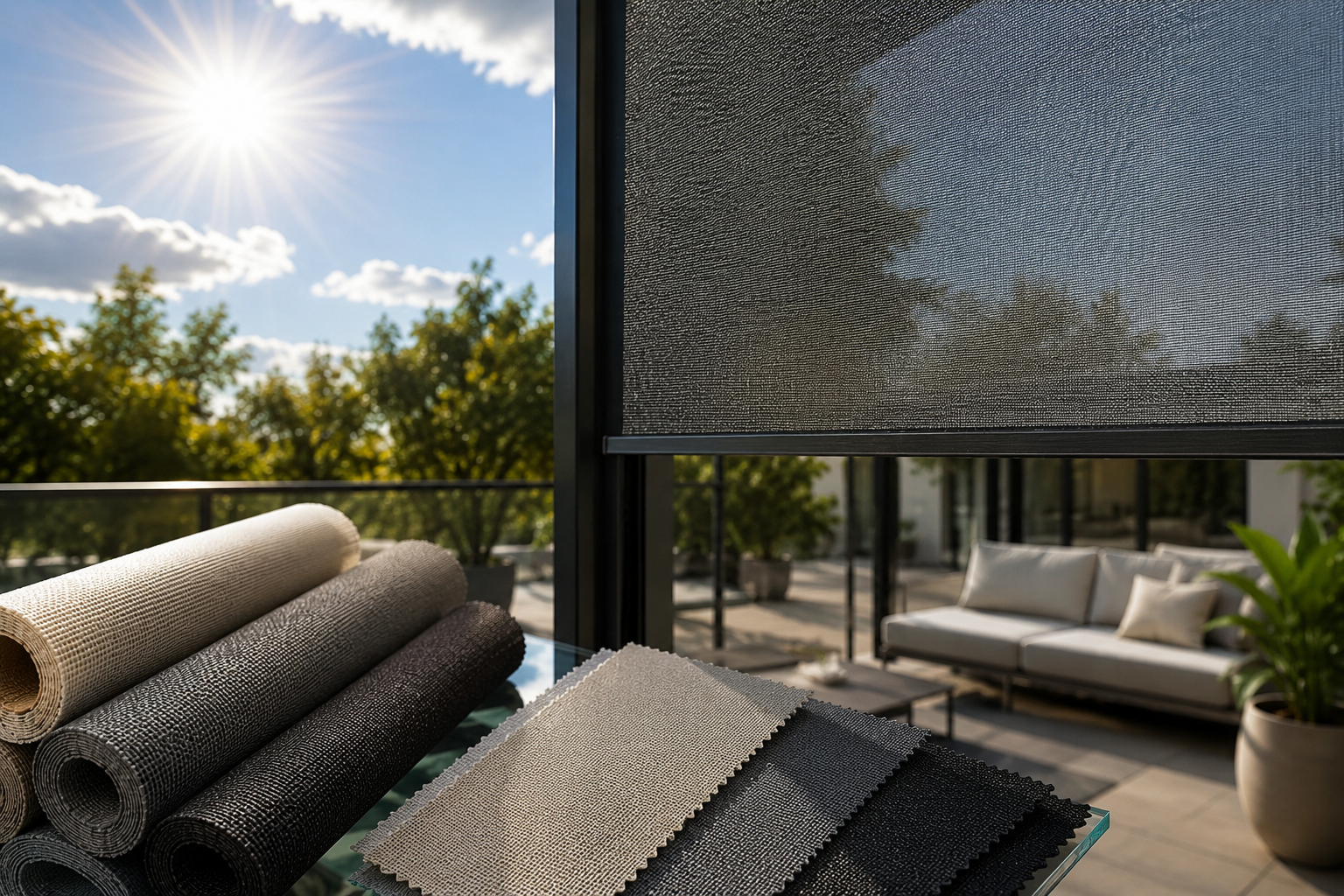
UPF vs UV Blockage
Two measurement systems are used to quantify UV protection in fabric, and they apply to very different contexts.
UPF (Ultraviolet Protection Factor)
UPF is a rating system developed for sun protective fabric in the clothing and textile industry. It indicates how much UV radiation is transmitted through the fabric to the skin beneath. A UPF 50 fabric allows only 1/50th (2%) of UV radiation to pass through blocking 98%.
UPF ratings are measured against direct skin contact, which makes them directly applicable to clothing, swimwear, and similar body covering applications. When you see references to UPF 50 fabric or UPF fabric by the yard in a retail context, you are in the clothing-adjacent textile world.
UV Blockage % in Architectural Shade Fabrics
For architectural and commercial shading applications roller blinds, zip screens, facade shading, awning systems UV performance is expressed as a percentage UV blockage rather than a UPF rating. The measurement methodology differs because the fabric is not in contact with skin; it is positioned between the sun and an interior space, and its interaction with the full solar spectrum matters as much as UV alone.
High-performance architectural shade fabrics routinely achieve 97% or greater UV blockage across all colorways. This means less than 3% of incident UV radiation passes through the fabric into the interior delivering protection for furnishings, flooring, artworks, and occupants that significantly exceeds what even UPF 50+ rated clothing textiles provide in a spatial sense.
The key distinction: UPF fabric by the yard is a clothing textile metric. UV blockage % in shade fabric is an architectural performance specification. Both are legitimate within their respective domains but they should not be confused when specifying a commercial or architectural project.
Why UV Protection Matters at the Building Level
The consequences of inadequate UV-protected fabric in architectural applications are slow, cumulative, and expensive.
Interior Material Degradation
UVA radiation is the primary driver of fading and material breakdown in interior environments. Carpet, hardwood flooring, leather upholstery, silk furnishings, artwork, and retail merchandise are all vulnerable to UV-induced photodegradation. The process is irreversible colours fade, fibres weaken, and materials lose structural integrity under sustained UV exposure.
A sun resistant fabric with 97% UV blockage reduces UV-induced interior degradation by a factor that makes a measurable difference over a 5–10 year horizon. For hospitality, retail, museum, and premium residential projects, this is a specification with direct financial consequences.
Occupant Health and Comfort
Extended exposure to UV radiation particularly UVA, which penetrates glass is a recognised health risk. Workplaces, healthcare facilities, and schools with large glazed facades expose occupants to cumulative UVA doses that add up over an eight-hour day, five days a week, fifty weeks a year. UV blocking fabric positioned at the window plane intercepts this radiation before it reaches occupants, providing meaningful protection without eliminating natural daylighting.
HVAC Load and Energy Efficiency
UV radiation represents a portion of the total solar energy spectrum, but the more significant architectural driver is the full solar heat gain associated with unshaded glazing. UV-resistant fabric in a shade system also reduces near-infrared (heat) radiation entering the space — reducing cooling loads and the energy consumed by HVAC systems to compensate. This is why solar performance data for architectural shade fabrics includes Solar Transmittance (TS) and Solar Reflectance (RS) alongside UV blockage — the full spectrum interaction matters.
How UV-Resistant Fabric Material Is Constructed
Not all UV blocking fabric achieves its performance in the same way. The construction method has direct implications for durability, maintenance, and long-term performance consistency.
Fiberglass-Core UV Fabric
The most dimensionally stable UV-resistant fabric material for architectural applications uses a woven glass fiber core coated with UV-stabilised PVC. The fiberglass core provides structural integrity near zero thermal expansion, no sagging or stretching under sustained tension while the PVC coating delivers the UV blocking performance and weathering resistance.
TepText's Fiberglass Sunscreen range achieves approximately 97% UV blockage across all colorways. The 70% PVC / 30% fiberglass composition (6000FR Series) and 65% PVC / 35% fiberglass composition (4000FR Series) represent two points on the stiffness flexibility spectrum both delivering exceptional UV protection, with the higher glass fiber content providing greater dimensional stability for large-format precision systems.
Solar performance data for the Fiberglass Sunscreen range, per colorway:
| Colorway | TS | RS | AS | TV |
|---|---|---|---|---|
| White-Beige (WINZIP-60802F) | 16 | 58 | 13 | 21 |
| Cream-Cream (WINZIP-60808F) | 14 | 52 | 32 | 13 |
| White-Grey (WINZIP-60207F) | 43 | 36 | 37 | 37 |
| Grey-Grey (WINZIP-601027F) | 72 | 17 | 27 | 27 |
| Charcoal-Grey (WINZIP-60110F) | 61 | 87 | 65 | 65 |
| Black-Black (WINZIP-61010F) | 12 | 26 | 62 | — |
TS: Solar Transmittance | RS: Solar Reflectance | AS: Solar Absorption | TV: Visual Transmittance
This data illustrates a critical point: UV blockage (~97%) is consistent across all colorways, but the solar heat management profile varies significantly with colour. White beige reflects 58% of total solar energy ideal for heat exposed facades. Charcoal grey absorbs 76% excellent for glare elimination but generates more fabric surface heat. Specifiers should select colorway based on the full TS/RS/AS/TV profile, not UV blockage alone.
PVC-Coated Polyester UV Fabric
TepText's PVC/Poly Sunscreen range uses a polyester yarn base with a UV-stabilised PVC coating. This construction delivers comparable UV blocking performance to fiberglass-core fabrics in a more flexible, handleable textile — better suited to indoor roller blind applications and smaller-format systems where the precision tracking requirements of large zip screens are not a factor.
For interior solar shading where the fabric is positioned inside the glazing plane rather than externally PVC/poly UV resistant fabric material is the standard specification across residential and commercial blind manufacturing.
UV Fabric Performance
A UV blockage percentage is a starting point, not a complete specification. Here is what experienced specifiers look for beyond the headline figure:
1. Is UV blockage specified per colorway or per product? UV performance can vary slightly between colorways due to pigment differences. A credible supplier provides per-colorway data. A supplier who only offers product-level UV blockage data has not tested all colorways independently.
2. How is UV resistance maintained over time? The PVC coating in a sun resistant fabric is UV stabilised to resist photodegradation but stabilisation quality varies. Ask for accelerated weathering test data (Xenon arc testing, EN ISO 105-B02 or equivalent) that demonstrates UV performance retention after simulated years of outdoor exposure.
3. What is the relationship between openness factor and UV blockage? This surprises many specifiers: UV blockage in shade fabrics comes primarily from the PVC coating on the yarn, not from the closed area of the weave alone. A 5% openness fabric with high quality UV stabilised PVC coating achieves ~97% UV blockage meaning the 5% open area allows approximately 5% UV transmission, and the remaining ~92% is blocked by the coated yarn. Zero-openness (blackout) fabrics achieve essentially complete UV blockage through the fabric body.
4. Does fire classification affect UV performance? No M1 and NFPA 701 fire resistance treatments are applied to the PVC compound, not to the UV stabilising additives. Dual certified fabrics (M1 + NFPA 701) deliver the same UV blocking performance as non fire rated variants of the same base fabric.
UV-Resistant Fabric by Application
Commercial Office and Healthcare Facades
Specify fiberglass core UV fabric with documented per-colorway solar performance data. The 5% openness factor is the standard specification balancing UV protection, glare control, and maintained outward view. Confirm M1 fire certification for any public building application. TepText's Fiberglass Sunscreen (6000FR or 4000FR Series) meets this specification profile.
Hospitality Hotels, Restaurants, Retail
UV protection in hospitality environments directly protects asset value furniture, furnishings, flooring, and fixtures represent significant capital investment. A fabric sun protector with 97% UV blockage extends the life of interior assets meaningfully. Combine with solar reflectance data (RS) to minimise cooling loads in facade integrated applications.
Residential Roller Blind and Interior Shading
PVC/poly sunscreen UV fabric delivers the right balance of UV protection, solar control, and aesthetic flexibility for residential interior applications. For rooms with valuable furniture, artwork, or significant south/west-facing glazing, UV blocking fabric as a roller blind specification is a straightforward return on investment calculation.
Outdoor Pergola and Terrace Shading
TepText's M32 and M36 Mesh Series provide UV protection in open-weave outdoor shade structures. Higher openness factors are paired with UV stabilised yarn construction that resists outdoor weathering. For pergola applications where occupant UV exposure reduction is a goal alongside shading and ventilation, mesh UV fabric is the appropriate specification.
Full Blackout UV Elimination
Where complete UV exclusion is required — premium home cinema, darkroom, photography studio, or sleep-optimised hospitality rooms TepText's Fiberglass Blackout and Polyester Blackout ranges deliver zero-openness construction that blocks UV transmission through the fabric body entirely.
Frequently Asked Questions
What is the difference between UPF 50 fabric and architectural UV-blocking shade fabric?
UPF 50 fabric is rated for skin contact UV protection in clothing applications it allows 2% UV transmission and is measured against direct skin exposure. Architectural UV blocking shade fabric is rated by UV blockage percentage (typically 95–97%) and is engineered for window and facade shading where the full solar spectrum interaction matters. Both are valid in their respective applications, but they address different problems and should not be directly compared.
Is sun resistant fabric the same as UV resistant fabric?
In practice, yes both terms refer to textiles engineered to block UV radiation. Sun resistant fabric is more commonly used in consumer and architectural contexts; "UV resistant fabric" is more technically precise. Both indicate that the textile has been designed and tested for UV performance beyond the baseline of untreated natural or synthetic fibres.
Does UV blocking fabric also reduce heat?
UV radiation represents approximately 5% of total solar energy. UV-blocking shade fabrics reduce UV transmission significantly, but the greater energy management benefit comes from blocking near infrared (heat) radiation and visible light captured in the Solar Transmittance (TS) value. A fabric with low TS blocks both UV and heat effectively; UV blockage alone is not a complete indicator of solar heat management.
Can UV protection fabric be used outdoors as a fabric sun protector?
Yes, provided the fabric is specified and tested for outdoor exposure. Not all UV resistant fabric materials are rated for continuous outdoor weathering. TepText's fiberglass core outdoor fabrics are engineered for sustained outdoor UV exposure UV stabilisation extends to the PVC coating itself, not just the performance of the fabric when new.
What is UV resistant fabric material made from?
High performance UV resistant fabric material for architectural shading is constructed from either fiberglass-core or polyester-core yarns, coated with UV stabilised PVC. The UV protection comes primarily from UV absorbing or UV reflecting additives incorporated into the PVC compound during manufacturing. The weave construction determines what percentage of UV passes through the open areas of the fabric.
