

What Is the Difference Between Solar Shades and Blackout Shades?
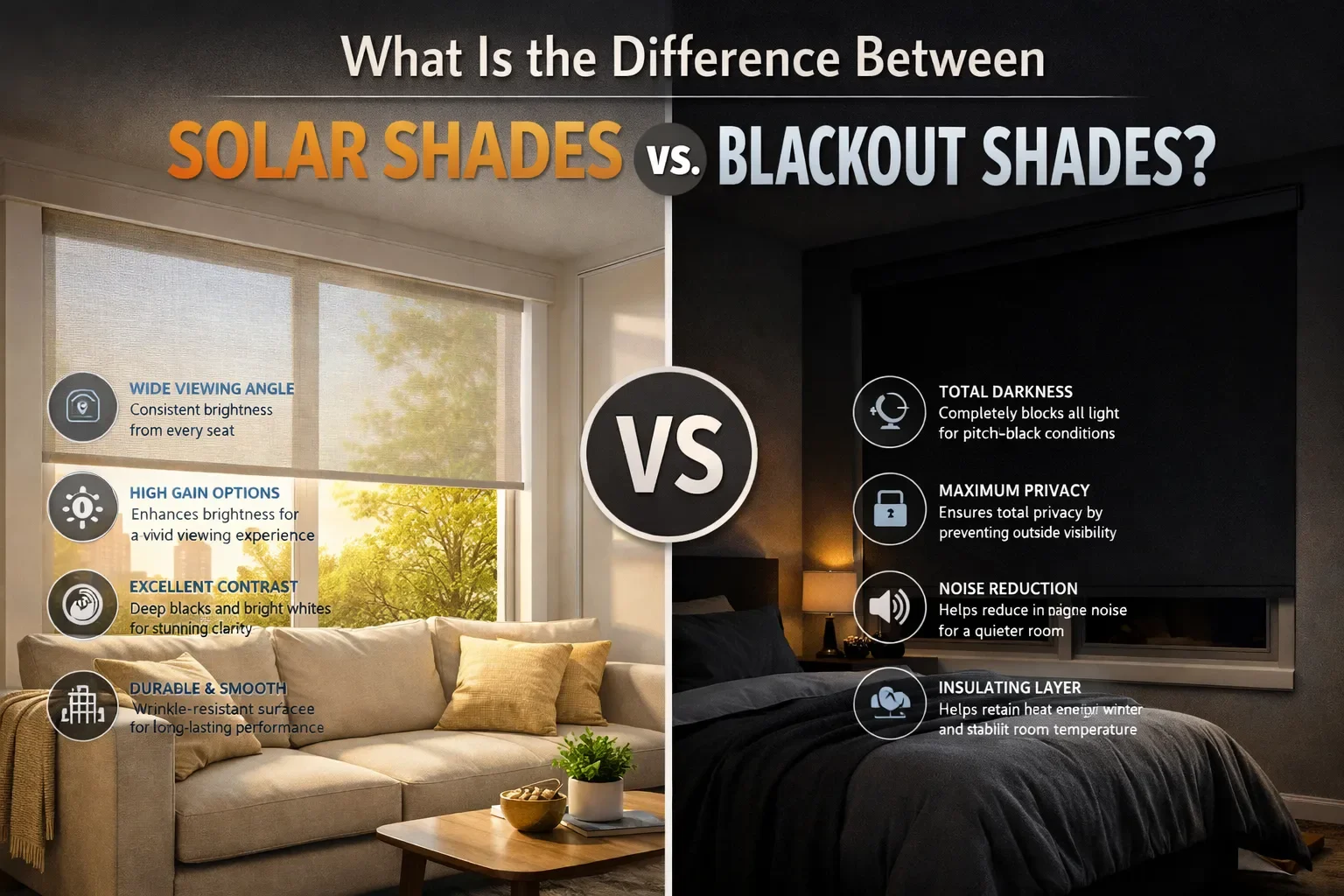
If you have ever tried to specify window treatments for a commercial project and felt like the terminology was working against you, you are not alone. Solar shades and blackout shades are both roller format window coverings. They can look almost identical in a cassette system. They are often made by the same manufacturers and sold through the same channels. And yet they do completely different things, and using one when you need the other is a specification error that generates complaints.
This article explains what actually separates them, when each is the right choice, and why many commercial and hospitality projects need both.
The Fundamental Difference
A solar shade is made from an open-weave fabric with a defined openness factor typically between 1% and 10%. The gaps in the weave allow some light, UV radiation and heat to pass through while the coated yarn blocks the rest. The result is a fabric that modulates solar radiation rather than eliminating it. You retain natural light, you maintain a view to the exterior, and you reduce glare and heat gain to manageable levels. You do not achieve darkness or complete privacy.
A blackout shade is made from a zero openness fabric. There are no gaps in the weave the fabric surface is continuous. When correctly installed, a blackout shade eliminates light transmission through the fabric body entirely. The room becomes dark regardless of what is happening outside. Views disappear. Natural light is replaced by whatever artificial lighting is in use.
These are not different points on the same spectrum. They are different products designed for different performance objectives, and the decision between them should be based on what the space actually requires rather than on which looks better in a sample book.
What Solar Shades Do Well
Solar shades are the right choice when the goal is to make a sun exposed space more comfortable and usable without losing the connection to the outside.
Glare is the most immediate benefit. Unmanaged direct sunlight through a large glazing panel creates patches of extreme brightness that make screens unreadable, cause eye strain, and generate complaints from occupants within hours of installation. A solar shade at 3% to 5% openness reduces that direct glare to a level where the space is comfortable while daylight still fills the room naturally.
Solar heat management is the second benefit. Solar screen fabric intercepts a significant proportion of the solar radiation that would otherwise pass through the glass and become heat inside the space. The exact proportion depends on the fabric's Solar Transmittance and Solar Reflectance values per colorway which is why those numbers should be part of any serious specification rather than an afterthought.
View-through is the third benefit, and for many clients it is the one they care about most. A well-specified solar shade at 5% openness allows occupants to see the exterior clearly during daylight hours. This is not just an aesthetic preference it has measurable effects on occupant wellbeing, particularly in workplace environments where access to daylight and views is associated with better mood, attention and productivity.
What Blackout Shades Do Well
Blackout shades are the right choice when complete darkness is the requirement. This sounds obvious, but it is worth being specific about the contexts where nothing less than blackout actually works.
Hospitality guest rooms are the clearest example. A hotel guest who wants to sleep at midday in a room with east-facing glazing needs genuine darkness, not reduced light. A solar screen at 1% openness still transmits direct morning sun through the fabric. A correctly installed blackout blind with minimal edge gaps does not. The difference between a rested guest and a complaint about insufficient blackout is often the specification decision.
Home cinema and AV presentation environments need complete light exclusion for projection quality. Even low levels of ambient light competing with a projected image degrade contrast significantly. Solar screen fabrics regardless of openness factor cannot achieve the darkness required for a quality projection environment.
Healthcare rooms with clinical light control requirements, such as diagnostic imaging suites or recovery areas where patients need to sleep at irregular hours, need reliable blackout that does not depend on exterior conditions.
Residential bedrooms are the most common context where this decision matters for end users. Shift workers, parents of young children, light-sensitive sleepers all need a level of darkness that solar screen fabric cannot provide.
The Color of Light That Matters
One nuance worth understanding is that solar shades and blackout shades manage different parts of the solar spectrum differently.
Solar screen fabric blocks a specific percentage of the total solar radiation based on its openness factor and colorway. It does not block all UV, all heat or all visible light it reduces them proportionally. A fabric with 97% UV blockage still transmits 3% of incident UV. A fabric with 5% openness still transmits 5% of visible light directly through the open areas of the weave.
Blackout fabric, by contrast, blocks all visible light transmission through the fabric body. It is not rated for UV blockage in the same way as solar screen, because the performance characteristic that defines it is total light exclusion rather than proportional solar control.
For applications where UV protection of interior contents is the specification objective preventing furniture fade, protecting artworks, managing UV exposure for occupants near south-facing glazing a solar screen fabric at high UV blockage is the appropriate specification. For applications where darkness is the objective, blackout is required regardless of UV performance.
Why Many Projects Need Both
The most effective window treatment specification for bedrooms, hotel rooms, healthcare patient rooms and any space that needs to serve different purposes at different times of day is a dual-layer system: solar screen for daytime use, blackout for darkness.
This combination solves the problem that neither product solves alone. Solar screen alone cannot achieve darkness. Blackout alone eliminates natural light and views during the day, which compromises the quality of the space during waking hours. Together, they provide the full range of light control that demanding applications require.
In a hotel guest room, this typically means a solar screen roller blind as the primary layer deployed during the day to manage glare and heat while the guest reads, works or enjoys the view and a blackout roller blind as a secondary layer, deployed at bedtime. Both operate independently, usually from the same wall switch or bedside control.
The specification question for dual-layer systems is not just which fabrics to choose but how the two layers interact mechanically. Both blinds need to fit within the window reveal or be mounted at the same facade position without conflicting. Cassette dimensions, tube diameters and bracket positions all need to be coordinated. This is a system design issue as much as a fabric specification issue, and it is much easier to address at design stage than during installation.
Indoor and Outdoor Versions of Each
Both solar screen and blackout fabrics are available in indoor and outdoor rated versions, and the distinction matters significantly for motorised facade systems.
Indoor-rated fabrics whether solar screen or blackout are not engineered for direct outdoor exposure. Their PVC coatings and construction are optimised for the milder UV and thermal environment of an interior application. Specifying an indoor fabric in an outdoor motorised system will result in premature degradation that voids any performance expectations.
Outdoor rated fabrics carry UV stabilised coatings formulated for sustained direct sun, rain, and temperature cycling. For external motorised zip-screen systems, fiberglass core construction is the appropriate specification for both solar screen and blackout applications, because the dimensional stability of the glass fiber core is the only construction that reliably maintains tracking performance in precision-guided motorised systems across years of outdoor operation.
TepText's outdoor range Fiberglass Sunscreen and Fiberglass Blackout is engineered for this context. The indoor range PVC/Poly Sunscreen and Polyester Blackout covers the interior specification. For most commercial and hospitality projects, the specification will draw on both.
For technical data sheets, samples or project specification support, contact TepText at info@teptext.com or explore the full product range at teptext.com.
