

Can You See Through Solar Screen Fabric? Day and Night Privacy
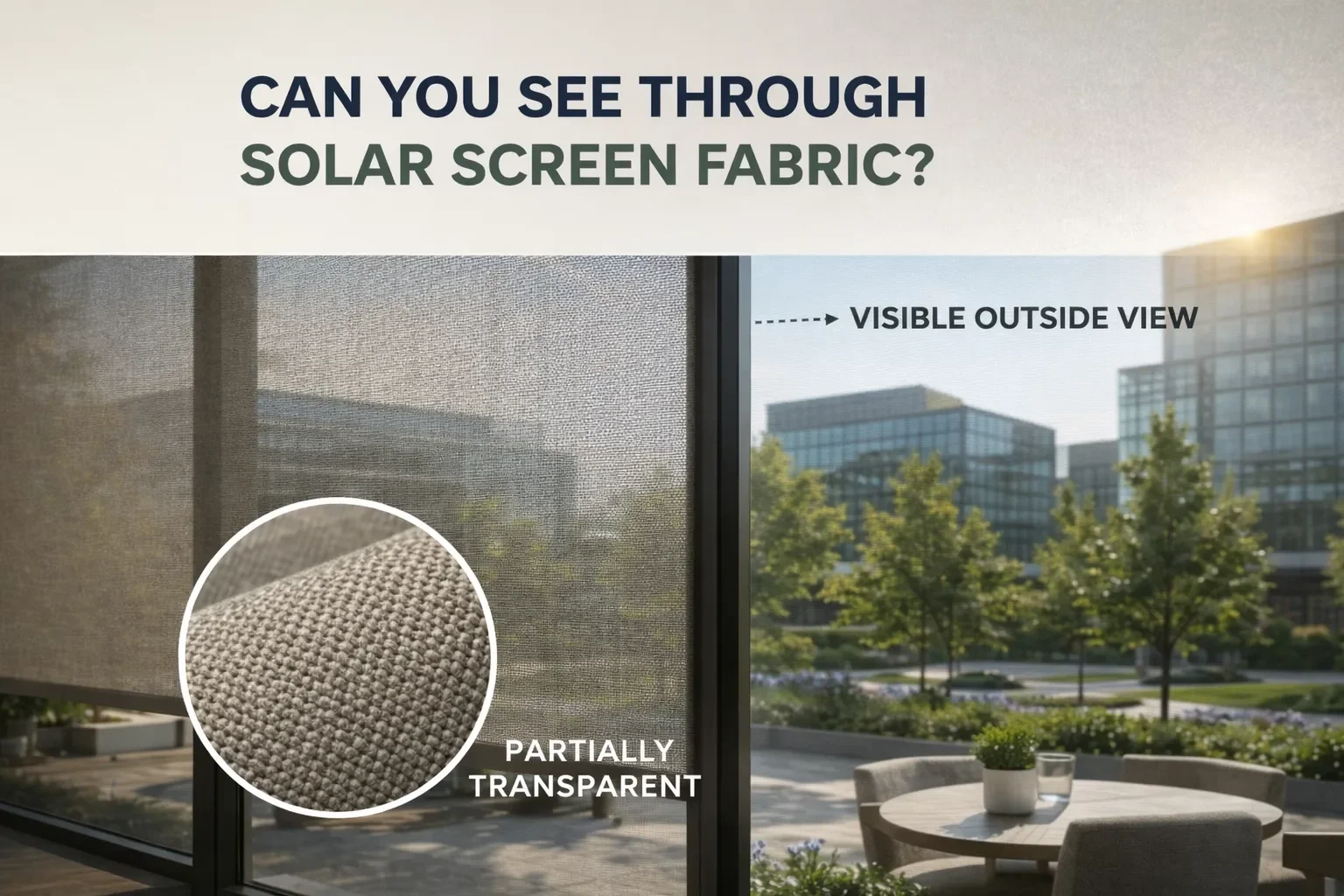
This is one of the most common questions in shade fabric specification and one of the most frequently misunderstood. People ask it in showrooms, in project briefings, and in online searches every day. The answer is genuinely nuanced, and getting it wrong at specification stage leads to complaints that could have been avoided entirely.
The short version: during the day, you can usually see out but not in. At night, with interior lighting on, that reverses. Understanding why this happens and how to specify accordingly is what this article covers.
The Physics Behind View-Through
Solar screen fabric works on the principle of light differential. The side with more light appears opaque to the side with less. During daylight hours, the exterior is brighter than the interior, so the fabric appears opaque from outside while remaining relatively transparent from inside. After dark, when interior lights are on and the outside is dark, the situation flips completely.
This is not a flaw in the fabric. It is a physical property of any semi transparent material, and it applies to every solar screen fabric regardless of the manufacturer or the price point. What varies between products is the degree of transparency how clearly you can see through in each condition and that is primarily determined by openness factor and the colorway's visual transmittance.
Openness Factor and What It Means for Visibility
Openness factor is the percentage of a fabric's surface area that is physically open gaps in the weave rather than coated yarn. A 5% openness fabric has 5% of its area open. A 1% openness fabric has 1%.
Higher openness means more transparency in both directions. A 10% openness fabric gives a clearer view out during the day, but also allows a clearer view in at night when interior lights are on. A 1% openness fabric is much harder to see through in either direction, at any time of day.
The practical ranges work roughly like this:
At 1% openness, the fabric provides very good daytime privacy. From outside, the fabric reads as nearly opaque even in favorable lighting conditions. View-through from inside is limited shapes and movement are visible but detail is reduced. Night time privacy is reasonable, though not absolute if interior lighting is bright.
At 3% openness, daytime privacy is good. An observer outside in normal daylight cannot see into the space. View from inside is clear and comfortable this is why 3% is the most common specification for commercial offices and hotel guest rooms. Night time privacy is reduced when interior lighting is on, and someone standing close to the outside of the glass may be able to see in.
At 5% openness, the daytime outward view is clear and the fabric reads as relatively transparent from inside. Privacy from outside is maintained in normal daylight conditions, but at lower light levels dusk, overcast days, or in situations where the exterior is shaded the differential narrows and some view in is possible. Night-time privacy with interior lighting on is limited.
At 10% openness, the fabric is close to transparent in both directions during daylight. Privacy is minimal in any light condition where the interior is illuminated.
Color Makes a Difference Too
Openness factor is not the only variable. The colorway of the fabric affects how much detail is visible through the open area, because darker fabrics create higher contrast between the yarn and the gap, which actually makes the weave structure more visible and can reduce perceived privacy.
A light-colored fabric with a given openness factor will often appear more opaque from outside than a dark fabric at the same openness, because the lower contrast between yarn and gap makes it harder to resolve detail through the weave. This seems counterintuitive dark fabric feels more private but the opposite is often true when tested in real conditions.
This is one more reason why reviewing actual Visual Transmittance data per colorway matters. It captures what is happening optically in a way that openness factor alone does not.
The Night-Time Situation: What Actually Happens
When interior lighting is on after dark, solar screen fabric provides very limited privacy. The light escaping from the interior through the open weave creates a glow that makes the space visible from outside, and at low openness factors the silhouettes of occupants and furniture are visible if someone looks directly at the window.
At 1% openness with interior lighting, the effect is relatively muted visible but not detailed. At 5% openness with strong interior lighting, the effect is more significant. At 10% openness, the interior is essentially visible to anyone outside the building.
This is not something that can be engineered away by choosing a different fabric in the same product category. It is an inherent property of any open-weave solar screen. If night time privacy through the fabric body is a genuine requirement for a bedroom, a consulting room, a private dining room, or any space where the occupants reasonably expect not to be visible from outside after dark a blackout layer is the appropriate specification, not a lower-openness solar screen.
When Solar Screen Alone Is Sufficient
For many commercial and hospitality applications, the night time transparency of solar screen fabric is not a significant problem in practice. An office floor that is empty in the evenings does not need night time privacy. A south facing hotel room where the guest closes the blackout blind at night and opens the solar screen during the day is already operating correctly. A restaurant where the ambient exterior lighting at night is comparable to the interior lighting level reduces the differential significantly.
The contexts where night time transparency becomes a genuine specification problem are:
Ground floor spaces in urban settings where pedestrians or vehicles pass close to the building perimeter in the evening. The combination of interior lighting and close proximity makes the view in effect much more noticeable.
Bedrooms and private residential rooms where occupants expect privacy in the evening without having to change the window treatment or turn off lights.
Healthcare consultation or treatment rooms where patient privacy during evening appointments is a regulatory requirement, not just a preference.
In any of these contexts, the specification answer is a dual system solar screen for daytime solar and glare management, blackout for evening and night-time privacy rather than attempting to solve both requirements with a single fabric.
Specifying for Privacy: A Practical Approach
If daytime inward privacy is a requirement, start at 3% or lower openness. The facade orientation and the distance from which the building will be observed both matter a ground floor room in a busy urban street has different privacy requirements from a fourth floor office in a suburban business park, even at the same facade orientation.
If night-time privacy is a requirement, specify a blackout layer. This is the only reliable approach. No solar screen fabric provides meaningful night time privacy when interior lights are on.
If view-out is a priority, go to 5% or higher. The trade off is less solar control and reduced daytime privacy at close range or in low exterior light conditions.
If the project involves a mix of requirements which most commercial and hospitality projects do treat each space type separately rather than applying a single openness specification across the building. The cost difference between getting this right and getting it wrong is almost never significant at specification stage. It becomes significant when the complaints start.
TepText supplies solar screen fabrics across the openness factor range for both indoor and outdoor applications, alongside Polyester Blackout and Fiberglass Blackout for dual-layer specifications. For technical data or project support, contact the team at info@teptext.com.
