

Projection Screen Fabric - What Makes a High Performance Silver Screen Material?
Projection screen fabric is a category that sits at the intersection of optical engineering and technical textiles. Unlike shade fabrics where performance is measured in solar transmittance, UV blockage, and dimensional stability projection screen fabric is evaluated on entirely different criteria: gain, viewing angle, colour neutrality, surface uniformity, and how the material interacts with projected light rather than solar radiation.
For home cinema installers, AV integrators, commercial presentation environment designers, and procurement professionals specifying projection systems, understanding what makes a screen fabric perform optically and how that performance is specified and measured is the foundation of a correct product selection.
This guide covers projection screen fabric from a technical standpoint: what the key performance parameters mean, how different screen materials serve different projection environments, and what to look for when specifying silver screen fabric for a professional or commercial installation.
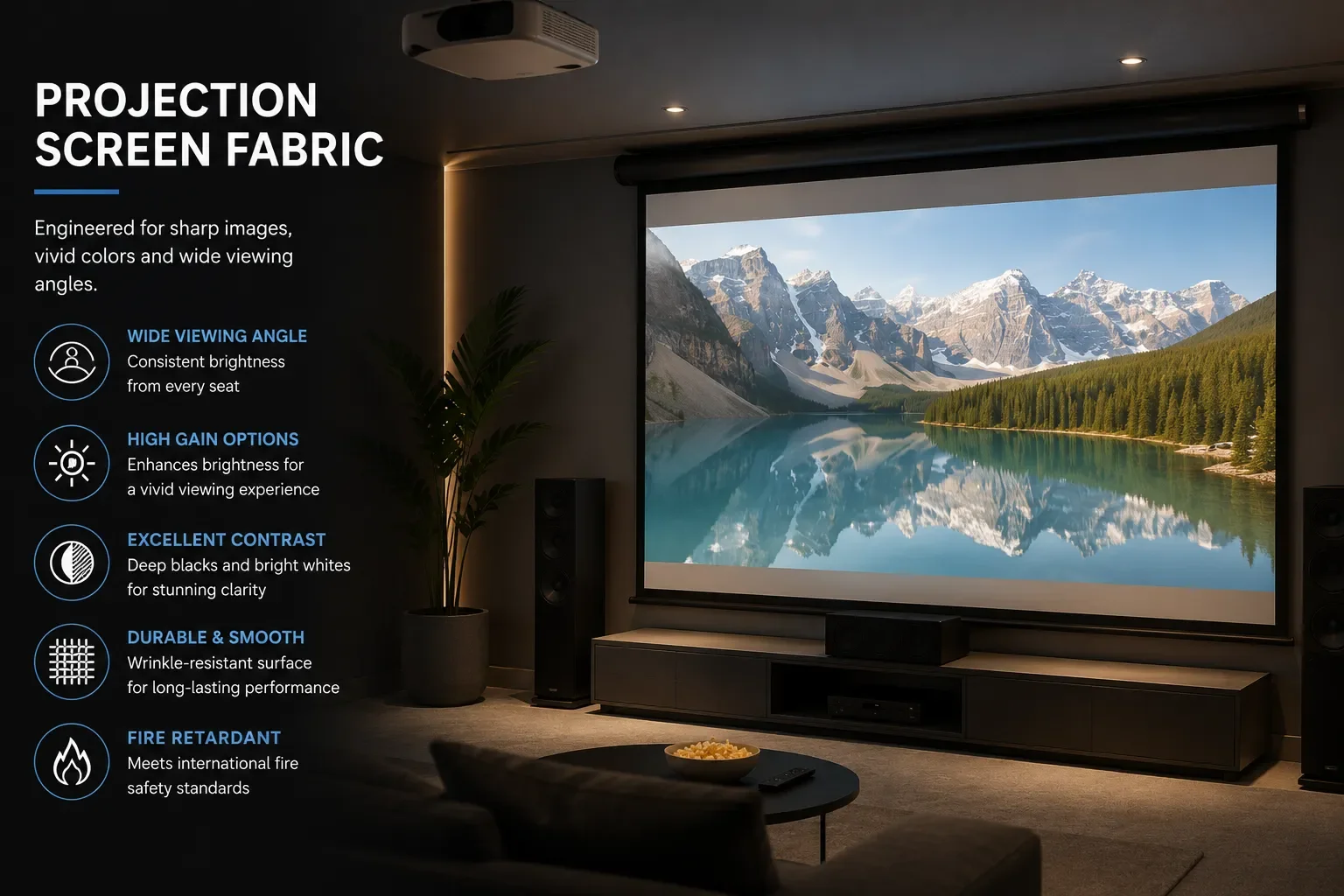
What Is Projection Screen Fabric?
Projection screen fabric is a precisely engineered textile or coated surface designed to reflect projected light toward the viewing audience with controlled gain, defined viewing angle, and high colour fidelity.
Unlike a painted wall or a stretched white sheet both of which will display a projected image in basic terms a projection screen fabric is engineered to:
Reflect projected light efficiently — maximising brightness at the viewer's position
Control the viewing cone — directing reflected light toward the audience rather than dispersing it omnidirectionally
Maintain colour neutrality — reproducing the projector's colour output faithfully without introducing colour shift
Reject ambient light — distinguishing between projected light and room illumination to maintain contrast in lit environments
Provide a uniform surface — eliminating hotspots, texture related artefacts, and surface irregularities that would degrade image quality
These objectives require materials engineered specifically for optical performance not repurposed shade or blackout fabrics, which have entirely different surface and optical characteristics.
Key Performance Parameters in Projection Screen Fabric
Gain
Screen gain is the ratio of light reflected by the screen surface compared to a reference white surface. A screen with gain of 1.3 reflects 30% more light toward the on axis viewer than the reference surface. A screen with gain of 0.8 reflects 20% less.
Higher gain sounds better and for environments with limited projector brightness, it can be. But gain and viewing angle are inversely related: a high gain screen concentrates reflected light in a narrow viewing cone. Viewers near the centre axis see a brighter image; viewers at wide angles see a significantly dimmer one. For large rooms with wide seating arrangements, a lower gain screen with a wider viewing angle delivers more uniform brightness across all viewer positions.
Typical gain values by application:
0.8–1.0 gain: Wide viewing angle, uniform brightness across large rooms. Suited to conference rooms, lecture theatres, and home cinema rooms with wide seating.
1.0–1.3 gain: Balanced brightness and viewing angle. Most versatile range for home cinema and commercial presentation.
1.3–2.0 gain: High brightness for environments with limited projector lumens. Narrow viewing angle best for rooms with controlled seating positions.
>2.0 gain: Very high brightness, very narrow viewing cone. Specialist applications.
Viewing Angle
Viewing angle defines how wide the usable seating area is in front of the screen. A screen with a 40° half gain angle delivers usable brightness across a 80° total cone; a screen with 20° half gain angle has a much more restricted usable zone.
For home cinema rooms with controlled seating positions directly in front of the screen, a narrower viewing angle is acceptable. For commercial conference rooms, educational lecture halls, or any space where viewers may be seated at wide angles to the screen, a wider viewing angle is an essential specification.
Colour Neutrality
A projection screen fabric should reflect all wavelengths of visible light equally preserving the colour balance of the projected image without introducing a colour cast. Screen materials with a grey tint can improve apparent contrast in ambient light conditions, but they must be designed to maintain colour balance across the visible spectrum rather than shifting the chromaticity of the projected image.
Silver screen fabrics including TepText's Silverscreen use a metallic or metallised surface that reflects projected light with high efficiency and controlled colour neutrality. The silver surface characteristic delivers the gain and directionality that defines this product category.
Surface Uniformity
Texture in a projection screen fabric is the enemy of image quality. Any surface irregularity weave texture visible in the projected image, coating thickness variation, or mechanical deformation from improper installation creates artefacts in the displayed image. High-quality projection screen fabrics are engineered and quality controlled for surface uniformity across the full roll width and length.
This is particularly important for large-format screens (cinema, commercial auditorium, large conference room) where even subtle surface non uniformity becomes visible at projection distances. The fabric must be dimensionally stable maintaining its flat geometry under the tension of the screen frame or roller installation without distortion, creep, or waviness.
Types of Projection Screen Fabric
Front Projection Fabric
Front projection screen fabric reflects light from a projector positioned in front of the screen, toward the audience. This is the standard configuration for home cinema, commercial conference, educational, and entertainment venue applications.
Front projection fabrics are available in white and grey (for enhanced apparent contrast in ambient light conditions the grey surface absorbs ambient room light more effectively than white, improving perceived black levels).
Silver screen fabric is a front projection surface with a metallised or pearlescent finish that provides higher gain and controlled directionality compared to standard white surfaces. It is well-suited to home cinema environments with controlled lighting conditions and seating positions, where higher gain delivers a brighter, more cinematic image from a standard-brightness projector.
Rear Projection Fabric
Rear projection screen fabric transmits projected light from behind the screen to the audience positioned in front. The optical requirements are different from front projection: the fabric must transmit light with controlled diffusion spreading the projected image evenly across the viewing angle without hotspots while maintaining sufficient opacity to prevent the projector unit from being visible to the audience.
Rear projection is used in applications where the projector must be concealed behind the screen — retail display, exhibition, broadcast studio backgrounds, and some commercial presentation environments. The fabric must be installed without wrinkles or tension irregularities, as any surface deformation becomes visible in the transmitted image.
Ambient Light Rejecting Screen Fabric
Ambient light rejecting screen fabrics use a micro-structured surface or lenticular optical geometry to distinguish between projected light and ambient room light. By preferentially reflecting the projected light and absorbing or redirecting ambient light, ALR screens maintain image contrast and colour saturation in fully or partially lit rooms.
ALR screen fabric is specified for boardrooms, commercial showrooms, retail environments, and any application where the projection system must perform in ambient lighting conditions where a standard front-projection screen surface would appear washed out.
TepText Silverscreen
TepText's Silverscreen is a projection screen fabric engineered for front projection applications in home cinema, professional AV, and commercial presentation environments. The silver surface finish delivers:
High reflectance efficiency — the metallised surface reflects projected light with greater directional efficiency than standard white projection surfaces
Controlled gain — optimised for home cinema and commercial presentation environments where seating positions are controlled and higher brightness is a specification objective
Colour neutrality — the silver surface is engineered to maintain colour balance across the visible spectrum, reproducing the projector's colour output faithfully
Surface uniformity — consistent surface quality across the full fabric width and length, essential for large-format screen applications without visible texture artefacts
The Silverscreen is positioned within TepText's Project Fabrics category — a distinct product family from the solar shading textiles, engineered specifically for projection optical performance rather than solar control.
For detailed technical data, gain specifications, viewing angle data, and sample requests for the Silverscreen, contact TepText at info@teptext.com or visit teptext.com/projectfabrics/silverscreen.
Specifying Projection Screen Fabric: Key Questions
For AV integrators, home cinema installers, and commercial project specifiers, these questions define the right screen fabric for a given installation:
1. What is the projector's lumen output, and what screen size is being specified? Screen gain should be selected in relation to projector brightness and screen area. A lower-lumen projector covering a large screen area benefits from higher gain; a high brightness projector in a smaller room may perform better with a lower gain, wider angle surface.
2. What are the ambient lighting conditions in the space? Fully controlled dark room cinema → standard white or silver front projection fabric. Partially lit commercial or residential space → consider grey front projection fabric or ALR specification. Fully lit commercial environment → ALR specification.
3. What is the seating arrangement? Controlled seating directly in front of the screen → higher gain acceptable. Wide seating arrangement with viewers at oblique angles → lower gain, wider viewing angle specification.
4. Is the installation front or rear projection? Front projection and rear projection require fundamentally different fabric specifications. Confirm the system geometry before specifying the screen fabric.
5. What installation format is the screen system? Fixed frame screens require a fabric with consistent dimensional stability under frame tension. Motorised roller screens require a fabric that rolls cleanly without crease formation. Curved screens require a fabric with sufficient flexibility to conform to the curve geometry without surface distortion.
Projection Screen Fabric vs Shade Fabric: Not the Same Product
A question that occasionally arises in specification discussions: can a white blackout fabric or a light coloured sunscreen fabric be used as a projection screen?
The answer is technically yes any flat, light coloured surface will display a projected image but the results will fall significantly short of a dedicated projection screen fabric on every relevant optical metric: gain, uniformity, colour fidelity, and hotspot control.
Shade fabrics including TepText's blackout and sunscreen range are engineered for solar control: blocking, absorbing, and reflecting solar radiation. Their surface geometry, coating chemistry, and reflectance characteristics are optimised for solar performance, not optical projection performance.
For any installation where image quality matters home cinema, professional AV, commercial presentation a purpose-engineered projection screen fabric is the only appropriate specification.
Frequently Asked Questions
What is silver screen fabric made from?
Silver screen projection fabric typically uses a woven or non woven base material with a metallised or pearlescent coating that provides the high reflectance, controlled directionality surface required for projection performance. The specific construction varies by manufacturer and product tier the performance is defined by the optical characteristics of the surface, not the base material alone.
What gain should I specify for a home cinema?
For home cinema with controlled seating positions and a dedicated dark room environment, gains of 1.0–1.5 are typical. Silver screen fabrics in this range deliver a bright, high contrast image from standard home cinema projector brightness levels. For very large screens or lower brightness projectors, higher gain may be appropriate but always verify the viewing angle is adequate for the room's seating layout.
Can projection screen fabric be used in a motorised roller system?
Yes projection screen fabric is available for both fixed frame and motorised roller installation formats. For motorised roller screens, the fabric must roll cleanly without crease formation and maintain surface uniformity after repeated deployment. Specify a fabric that the manufacturer explicitly rates for motorised roller installation.
Is rear projection fabric the same as front projection fabric?
No they are different products with different optical constructions. Rear projection fabric is designed to transmit projected light with controlled diffusion; front projection fabric is designed to reflect projected light toward the audience. Using front projection fabric in a rear projection configuration or vice versa will not deliver acceptable image quality.
How do I clean projection screen fabric?
Projection screen fabric should be cleaned with a soft, lint free cloth and mild cleaning solution appropriate for the specific fabric surface. Avoid abrasive cloths, solvents, or aggressive cleaning that could damage the optical coating. For fixed frame installations, cleaning in place with careful technique is standard practice. For motorised roller installations, the screen can be fully extended for cleaning access.
