

Is Polyester UV Resistant? What Architects and Blind Manufacturers Need to Know
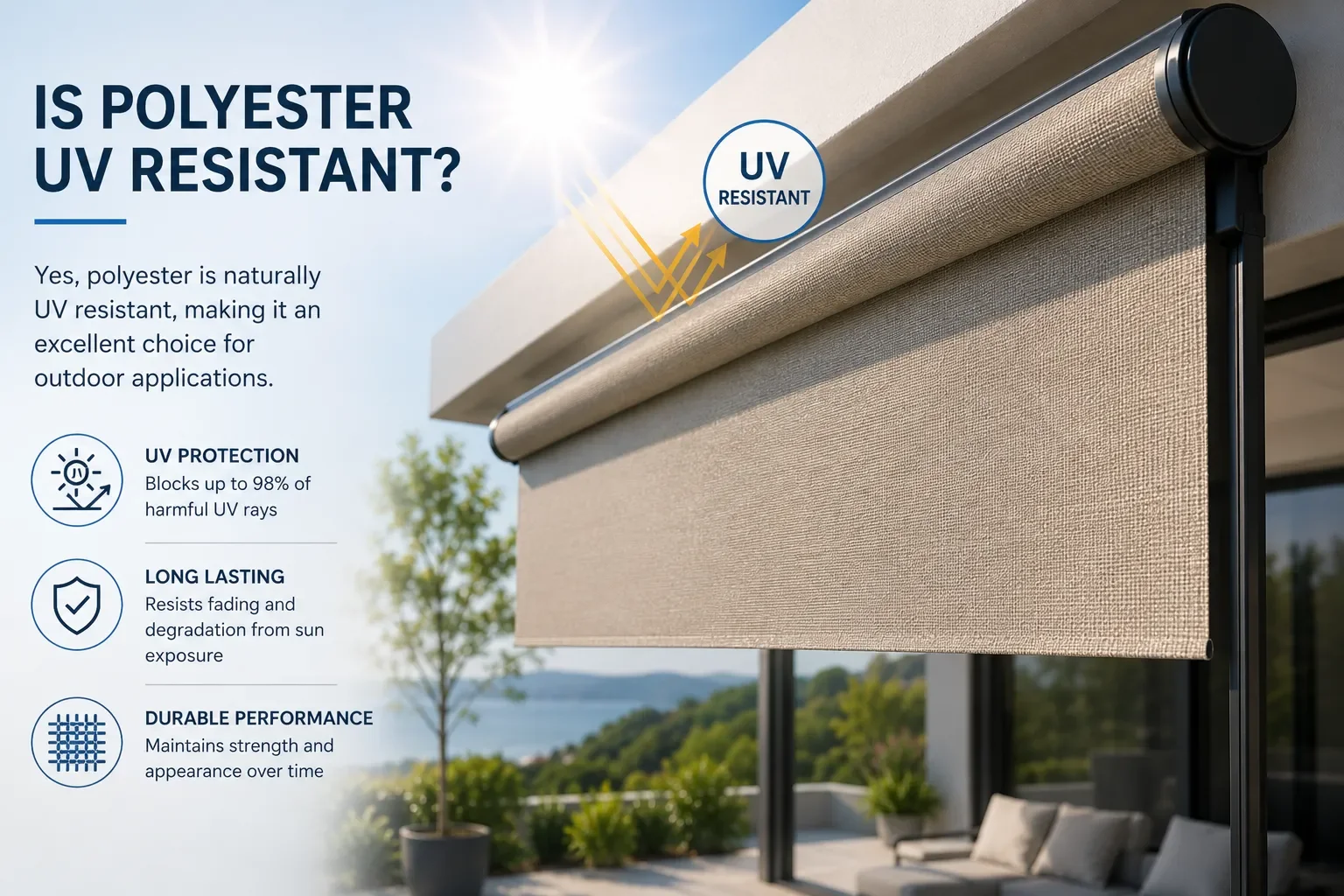
Is polyester UV resistant?" is one of the most commonly asked questions in outdoor textile specification and one of the most incompletely answered. The short answer is: polyester has moderate inherent UV resistance, but without UV stabilisation treatment, it will degrade under sustained outdoor solar exposure in ways that matter for performance-critical applications.
For architects, blind manufacturers, and procurement professionals specifying shade fabrics for outdoor applications, the relevant question is not whether polyester is UV resistant in principle, but whether a specific PVC coated polyester product has been engineered and tested for the UV exposure conditions of the intended installation. The difference between those two questions determines whether a fabric specification performs for ten years or fails within three.
This guide gives you the technical framework to evaluate polyester UV resistance in shade fabric products and to understand when PVC/poly construction is appropriate and when a fiberglass-core alternative is the better specification.
Polyester and UV Radiation: The Baseline
Polyester absorbs UV radiation in the 300 400nm range the UVA region that reaches the earth's surface in significant quantities. This absorption is what causes UV induced degradation in untreated polyester: the UV energy breaks chemical bonds in the polymer chain, leading to loss of tensile strength, colour fading, and surface embrittlement over time.
The rate of UV induced degradation in polyester depends on:
UV exposure intensity: Geographic latitude, altitude, facade orientation, and hours of direct sun exposure all determine cumulative UV dose over a service life.
Temperature: UV degradation in polymers is accelerated by heat. A fabric in a hot climate under direct south-facing sun degrades faster than the same fabric in a temperate north facing application.
Polymer formulation: Different grades of polyester have different UV stability. Standard commodity polyester degrades faster than UV-stabilised polyester grades used in technical outdoor textiles.
Surface coating: A PVC coating over the polyester yarn dramatically changes the UV exposure profile of the underlying fiber the coating intercepts UV before it reaches the polyester core.
This last point is critical for understanding UV resistance in PVC coated polyester shade fabrics: in a well-constructed PVC/poly fabric, the polyester yarn is almost entirely protected from UV by the PVC coating. UV resistance in the fabric system depends primarily on the UV stability of the PVC coating not the polyester core.
PVC Coating and UV Stability: Where the Real Specification Lives
In a PVC coated polyester shade fabric, the PVC coating is the primary UV barrier. The coating absorbs, reflects, or transmits solar radiation before it reaches the polyester yarn beneath. The long term UV resistance of the fabric system is therefore determined by the UV stabilisation of the PVC compound specifically, whether UV absorbing or UV stabilising additives have been incorporated into the PVC formulation during manufacturing.
Unstabilised PVC coating: UV radiation attacks the PVC compound, causing progressive degradation chalking, colour shift, surface cracking, and eventually coating embrittlement. As the coating degrades, it provides progressively less protection to the underlying polyester yarn, accelerating system level degradation.
UV-stabilised PVC coating: UV absorbing additives in the PVC compound intercept UV energy before it causes photochemical damage. The coating maintains its integrity, appearance, and protective function across years of outdoor exposure.
The distinction between stabilised and unstabilised PVC is invisible in a product sample it shows up in accelerated weathering test data and in real world performance after two to three seasons of outdoor exposure. This is why technical buyers ask for weathering test documentation rather than relying on product descriptions.
PVC-Coated Polyester in Outdoor Shade Fabric: Where It Works
Understanding the UV stability of PVC/poly construction clarifies where it is and is not appropriate for outdoor shade fabric applications.
Indoor Roller Blind Applications
For interior roller blind systems fabric positioned inside the glazing plane, exposed to solar radiation filtered through glass a quality PVC/poly sunscreen fabric provides excellent UV protection performance and long service life. The glazing filters out the most energetic short-wave UV before it reaches the fabric, reducing the UV dose to which the PVC coating is exposed. Interior conditions also involve less severe thermal cycling than direct outdoor exposure.
TepText's PVC/Poly Sunscreen is engineered for this application context. It delivers approximately 95–97% UV blockage as a solar shading product meaning it blocks that proportion of UV from entering the space while the fabric itself is exposed to the milder UV environment of the interior face of the glazing system.
Light Outdoor Applications
For shade structures with intermittent outdoor exposure covered walkways, canopies with significant roof overhang, secondary skin installations with limited direct sun exposure UV stabilised PVC/poly fabric can perform well in outdoor conditions.
The critical variables are cumulative UV dose and thermal cycling severity. A fabric installed with significant shading from above, in a temperate climate with moderate annual sunshine hours, faces a very different UV environment from the same fabric installed unshaded on a west-facing commercial facade in a Mediterranean climate.
Where PVC/Poly Has Limitations Outdoors
For direct outdoor exposure in high-insolation climates particularly for precision motorised zip-guided systems where dimensional stability under thermal cycling is a mechanical requirement fiberglass core coated fabric is the technically superior specification.
The limitation of PVC/poly in these demanding outdoor contexts is not primarily UV resistance of the coating but dimensional stability of the polyester core. Polyester expands and contracts meaningfully with temperature. For free hanging shade structures, this movement is accommodated without consequence. For zip-guided motorised systems with tight channel tolerances, the cumulative effect of thermal expansion and contraction leads to progressive tracking degradation over time a mechanical failure mode, not a UV failure mode.
Fiberglass vs PVC/Poly: UV Resistance Comparison
Both fiberglass-core and PVC coated polyester shade fabrics can achieve comparable UV blockage performance as measured by UV transmission through the fabric approximately 95–97% for quality products in both categories.
The UV-related performance difference between the two constructions lies in weathering durability how the fabric system maintains its UV blocking performance over time under outdoor exposure.
| Performance Dimension | PVC/Poly (UV-stabilised) | Fiberglass (UV-stabilised) |
|---|---|---|
| Initial UV blockage | ~95–97% | ~97% |
| UV coating stability (outdoor) | Good | Excellent |
| Thermal cycling effect on UV performance | Minimal direct effect | Minimal direct effect |
| Long-term outdoor colour stability | Good (stabilised grades) | Excellent |
| Dimensional stability under heat | Moderate | Near-zero expansion |
| Recommended outdoor service life | 8–12 years | 10+ years |
| Appropriate for direct outdoor motorised systems | Limited | Yes |
The conclusion for technical specifiers: both constructions can deliver high UV blockage performance. For indoor and light outdoor applications, UV-stabilised PVC/poly is a technically sound specification. For demanding outdoor motorised applications with precision tracking requirements, fiberglass-core fabric is the correct choice — not primarily for UV performance, but for dimensional stability that maintains system integrity across thermal cycling.
How to Evaluate UV Resistance in a Shade Fabric Product
When evaluating any PVC-coated polyester shade fabric for outdoor application, ask the following:
1. Is the PVC coating UV-stabilised, and what stabilisation system is used? A credible technical manufacturer will be able to describe their UV stabilisation approach. Products marketed simply as "UV resistant" without reference to the coating formulation or test data are making a claim, not a specification.
2. What accelerated weathering data is available? Xenon arc weathering tests simulate years of outdoor UV exposure in weeks of laboratory testing. A fabric with documented weathering test data showing colour retention and physical property retention after simulated outdoor exposure provides a technical basis for outdoor specification. A fabric without this data requires a leap of faith.
3. What is the stated or demonstrated outdoor service life? A responsible supplier can provide either accelerated test data, real world installation case studies, or a clearly stated expected service life for outdoor applications. If none of these is available, the product is not adequately documented for professional outdoor specification.
4. Is the fabric recommended by the manufacturer for the specific outdoor application? Some PVC/poly fabrics are described as "outdoor capable" but are designed and tested primarily for indoor use. Verify that the manufacturer explicitly rates the product for the exposure conditions of the intended installation direct outdoor, motorised, continuous deployment.
TepText Polyester and Fiberglass UV Fabric Portfolio
PVC/Poly Sunscreen — Indoor: UV stabilised PVC coated polyester, ~95–97% UV blockage as a solar shading product. Engineered for interior roller blind and solar shading applications in residential and commercial buildings. M1 fire certified. Available in multiple openness factors and colorways. → teptext.com/indoorfabrics/pvcpoly-sunscreen
Fiberglass Sunscreen — Outdoor: UV stabilised PVC coated fiberglass, ~97% UV blockage, near zero thermal expansion. Engineered for direct outdoor exposure and motorised zip-guided systems. M1 + NFPA 701 fire certified. Per-colorway solar performance data provided. Widths to 320cm. → teptext.com/outdoor-fabrics/fiberglasssunscreen
Polyester Blackout — Indoor: Zero-openness PVC-coated polyester. Total light exclusion in the fabric body. M1 certified. For interior roller blind blackout applications. → teptext.com/indoorfabrics/polyester-blackout
For technical data sheets, weathering test documentation, or application specific specification guidance, contact TepText at info@teptext.com.
Frequently Asked Questions
Does polyester block UV rays?
Untreated polyester fabric has moderate inherent UV absorption it blocks some UV but not at the levels required for shade fabric performance specifications. In PVC coated polyester shade fabrics, the UV blocking performance comes primarily from the PVC coating, not the polyester yarn. A quality UV stabilised PVC/poly shade fabric achieves approximately 95–97% UV blockage.
Is polyester fabric safe for outdoor use?
UV stabilised PVC coated polyester shade fabric is suitable for many outdoor applications particularly where UV exposure is moderate and dimensional precision under thermal cycling is not a critical system requirement. For demanding outdoor motorised systems, fiberglass core fabric is the more robust specification.
How long does polyester outdoor fabric last?
Quality UV-stabilised PVC coated polyester shade fabric in appropriate outdoor applications typically performs for 8–12 years. Service life depends heavily on UV exposure intensity, temperature cycling severity, and whether the PVC coating is genuinely UV stabilised with documented test data.
What is the difference between UV resistant polyester and standard polyester?
Standard polyester degrades progressively under sustained UV exposure losing tensile strength, fading, and becoming brittle. UV resistant polyester or more accurately, polyester with a UV stabilised PVC coating in shade fabric applications incorporates UV absorbing or UV stabilising additives that slow or prevent photodegradation. The difference shows up clearly after two to three seasons of outdoor exposure.
Is fiberglass more UV resistant than polyester in shade fabrics?
Glass fiber itself is inert to UV radiation it does not degrade under UV exposure. In PVC coated fiberglass fabrics, the UV resistance of the coating formulation is the same quality variable as in PVC/poly fabrics. The advantage of fiberglass over polyester in outdoor shade applications is dimensional stability under thermal cycling, not superior UV resistance of the coating.
