

What Is Openness Factor in Solar Screen Fabric?
Openness factor is the single most important technical parameter in solar screen fabric specification and one of the most frequently misunderstood. Ask a facilities manager what openness factor their roller blinds are specified at, and most will not know. Ask a blind manufacturer why they chose a 3% openness over a 5%, and the answer is often "that's what the client asked for" rather than a performance-based rationale.
This guide explains what openness factor actually means, how it interacts with every other solar performance metric, and how to select the right openness factor for a given application. It is written for architects, interior designers, project specifiers, and blind manufacturers who need to make this decision on technical grounds rather than intuition.
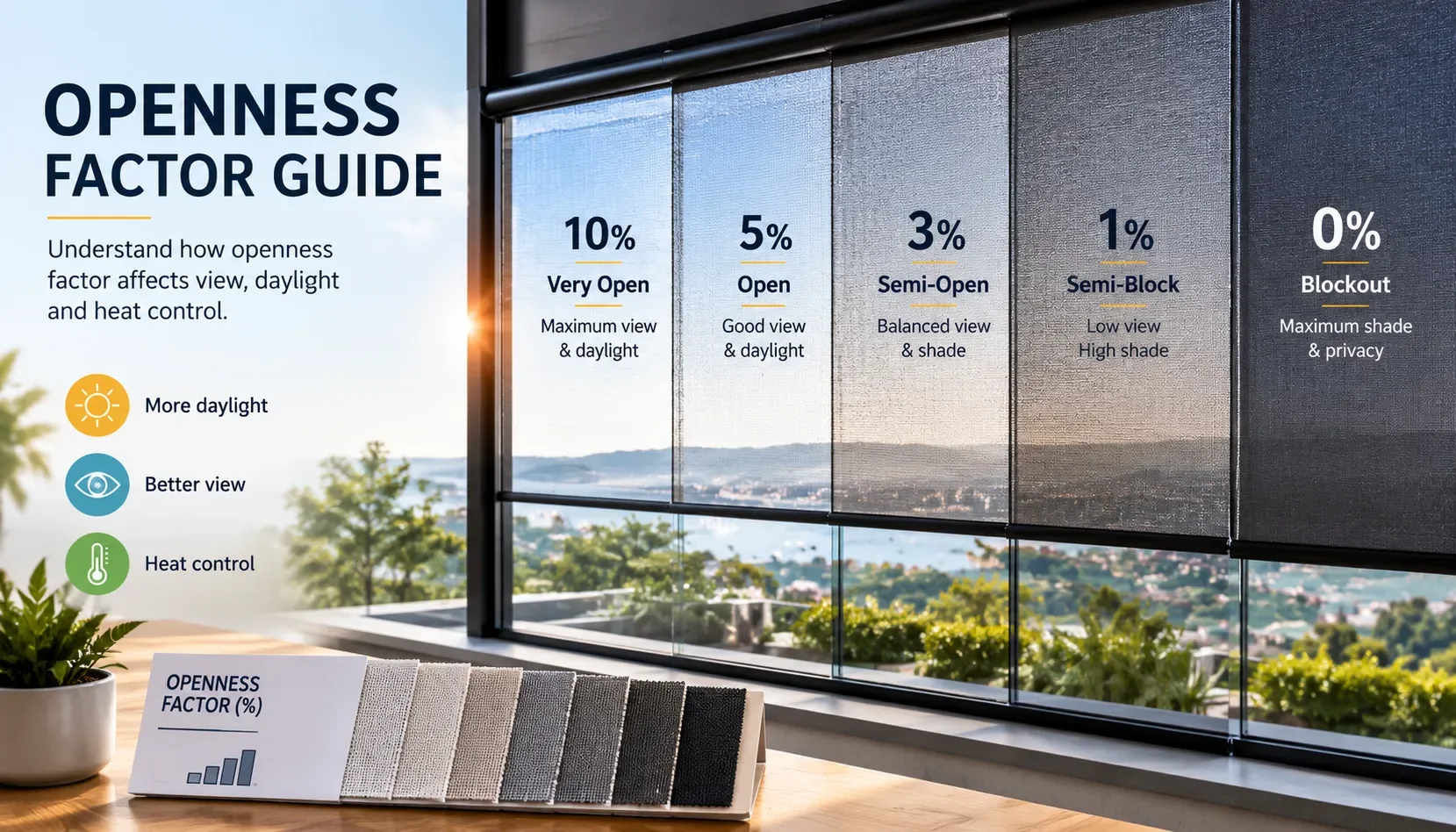
What Is Openness Factor?
Openness factor (OF) also referred to as openness percentage or open area factor is the percentage of a shade fabric's surface area that is physically open: the gaps between the coated yarns in the weave structure.
A fabric with a 5% openness factor has 5% of its surface area open and 95% covered by coated yarn. A 1% openness fabric has 1% open area. A 0% openness fabric blackout has no open area at all.
This sounds straightforward, but the implications of openness factor ripple through every other performance metric in the fabric: UV protection, solar transmittance, visual transmittance, glare control, privacy, and view-through all change as openness factor changes.
How Openness Factor Is Measured
Openness factor is measured by analysing a scanned or photographed image of the fabric at sufficient resolution to distinguish yarn from gap. Specialist software calculates the ratio of open area to total surface area, expressed as a percentage.
Credible manufacturers measure and state openness factor per product not per colorway, since the weave geometry does not change with colour. However, the effect of openness factor on solar and visual performance does vary with colorway, because darker yarns absorb more energy in the covered 95–99% of the fabric surface.
Openness Factor and Solar Performance: The Relationship
Here is where most specification conversations go wrong: openness factor is treated as if it directly equals solar transmittance. It does not.
Consider a fabric with 5% openness factor and approximately 97% UV blockage in the yarn:
The 5% open area allows approximately 5% of all incident radiation to pass through unimpeded light, UV, and heat.
The remaining 95% of the surface transmits a small additional fraction of solar energy through the coating itself.
The result is a total Solar Transmittance that is higher than the open area alone typically 10–20% for a 5% OF fabric, depending on colorway.
This is why Solar Transmittance data must be provided per colorway: a white beige yarn reflects more energy back from the covered surface, resulting in lower overall TS. A dark charcoal yarn absorbs more, resulting in higher overall TS more heat enters the space even through the covered portion of the fabric.
Practical implication: Openness factor tells you the weave geometry. Solar Transmittance tells you the actual energy passing through the fabric. Both numbers are needed for a complete specification.
The Four Performance Metrics That Work With Openness Factor
Every shade fabric data sheet should provide these four values per colorway. Together with openness factor, they give a complete picture of solar performance.
TS — Solar Transmittance: The percentage of total solar energy that passes through the fabric into the space. Lower TS = better heat rejection. Target TS values for commercial facade shading typically range from 4% to 20% depending on climate and facade orientation.
RS — Solar Reflectance: The percentage of total solar energy reflected back by the fabric surface. Higher RS = better heat management. Light-coloured fabrics carry the highest RS values sometimes exceeding 50% making them the technically superior choice for south and west-facing facades in hot climates.
AS — Solar Absorption: Energy absorbed into the fabric itself. High AS means the fabric surface becomes warm and re-radiates heat into the space relevant for interior blind applications where the fabric is close to the occupied zone.
TV — Visual Transmittance: The percentage of visible light transmitted through the fabric. TV determines how much natural daylighting is preserved while shading is active critical for occupant wellbeing and artificial lighting energy consumption.
The relationship between these values and openness factor is non-linear and colorway-dependent. This is why generic product-level data is insufficient for serious specification per colorway data is essential.
Openness Factor Options: 1%, 3%, 5%, 10% — What Each Delivers
1% Openness Factor
The most closed weave in the standard commercial sunscreen range. Maximum solar control and privacy. View-through from inside is significantly limited, particularly at night or in bright exterior conditions.
Typical TV: 1–5% Best for: Bedrooms, healthcare facilities, hospitality room-darkening (where full blackout is not required), privacy-critical commercial interiors, west-facing facades in high-insolation climates.
Not appropriate for: Workplaces where natural daylighting and external view are design requirements, or any application where the occupant's connection to the exterior is a wellbeing objective
3% Openness Factor
The most commonly specified openness for commercial interior roller blind applications. A 3% OF fabric provides strong solar control and meaningful privacy while preserving a usable level of natural light and a degree of view-through.
Typical TV: 3–10% (varies with colorway)
Best for: Commercial offices, hotel rooms, retail interiors, educational facilities, healthcare waiting areas. The balance point for most commercial specifications where solar control, privacy, and daylighting must all be addressed.
5% Openness Factor
The standard specification for external motorised zip-screen systems and commercial facade shading. 5% OF is widely used because it provides effective solar heat rejection and UV protection while maintaining a meaningful connection to the outside — occupants can see through the fabric, read external conditions, and feel connected to the exterior environment.
Typical TV: 5–21% (varies significantly with colorway) Best for: Motorised zip-screen systems, commercial facade shading, hospitality terrace and pergola applications, sunrooms, restaurant and café environments where outward view is part of the experience.
TepText's Fiberglass Sunscreen and Fiberglass Blackout outdoor ranges are engineered at 5% openness the industry benchmark for precision motorised systems requiring dimensional stability under outdoor exposure.
10% Openness Factor
Higher transparency, maximum natural light, clearest outward view. Reduced solar and privacy performance relative to lower-OF options.
Typical TV: 10–30% Best for: Applications where daylighting is the primary objective and solar heat rejection is secondary — north-facing facades in temperate climates, covered outdoor living areas, pergola shading where view to the garden or landscape is the design intent.
Not appropriate for: Facades with significant solar heat gain requirements, privacy-sensitive interiors, or any context where glare control is a primary performance objective.
Openness Factor and View-Through: The Day/Night Reversal
One of the most important — and least communicated — characteristics of open-weave shade fabric is the day/night reversal of view-through direction.
During the day: The fabric is brighter on the exterior than the interior (assuming natural daylighting conditions). Occupants inside can see through the fabric to the exterior. From outside, the fabric appears opaque — privacy is maintained.
At night: When interior lighting is activated with no exterior illumination, the light gradient reverses. The interior becomes brighter than the exterior. View-through reverses — people outside can see in; people inside cannot see out.
This reversal is inherent to all open-weave shade fabrics regardless of openness factor. The solution for applications requiring night-time privacy is either a lower openness factor (which reduces but does not eliminate the reversal), a secondary blackout layer, or a motorised blackout system as a complement to the solar screen.
Openness Factor for Blackout Applications
Where the specification requires total light exclusion — full blackout — openness factor drops to zero. Both TepText's Fiberglass Blackout (outdoor) and Polyester Blackout (indoor) ranges are engineered at 0% openness: no light, UV, or heat passes through the fabric body.
Blackout fabrics are the appropriate specification for:
Hospitality rooms requiring total darkness for guest sleep quality
Home cinema and AV presentation environments
Healthcare facilities where light control is clinically relevant
Any space where the solar screen's primary function is complete light exclusion rather than solar control with maintained view
Common Specification Mistakes - and How to Avoid Them
Mistake 1: Specifying openness factor without colorway performance data. Openness factor without TS/RS/AS/TV data per colorway is an incomplete specification. A 5% OF white-beige fabric and a 5% OF charcoal fabric have the same weave geometry but very different solar heat management profiles. Always request per-colorway performance data.
Mistake 2: Assuming lower openness = better performance in all cases. Lower openness improves privacy and heat rejection, but reduces natural daylighting (TV) and can negatively affect occupant wellbeing in workplaces. The right openness factor is a function of the project's specific performance objectives — not a universal "more closed is better" rule.
Mistake 3: Not accounting for the day/night privacy reversal. Many clients are surprised to discover that their 5% OF solar screen provides excellent daytime privacy but limited night-time privacy when interior lighting is on. This should be communicated at specification stage, with options presented for combined solar screen and blackout systems where night-time privacy is required.
Mistake 4: Specifying the same openness factor for all facades. A north-facing office facade in a temperate climate and a south-facing hotel room facade in a Mediterranean climate have fundamentally different solar performance requirements. Openness factor — and colorway — should be selected per facade orientation and climate zone, not applied uniformly across a project.
TepText Solar Screen Fabrics by Openness Factor
TepText's sunscreen fabric portfolio covers the key openness factor specifications for both indoor and outdoor applications.
5% Openness — Fiberglass Sunscreen (Outdoor): The 4000FR and 6000FR Series are engineered at 5% openness for precision motorised systems. Available in six colorways from white-beige to black. Full per-colorway TS/RS/AS/TV data provided. M1 + NFPA 701 fire certified. Widths to 320cm.
5% Openness — PVC/Poly Sunscreen (Indoor): PVC-coated polyester at 5% openness for interior roller blind applications. Suitable for residential and commercial interior specification.
0% Openness — Fiberglass Blackout & Polyester Blackout: Full blackout construction for total light exclusion in motorised outdoor systems and interior roller blind applications respectively.
For detailed technical data, per-colorway performance sheets, or openness factor selection consultation for a specific project, contact TepText at info@teptext.com.
Frequently Asked Questions
What openness factor is best for office roller blinds?
For commercial office environments, 3–5% openness is the standard specification range. 3% provides stronger solar control and privacy; 5% preserves more natural light and outward view. The right choice depends on facade orientation, climate, glazing specification, and whether a secondary blackout is included in the system design.
Does openness factor affect fire certification?
No fire certification (M1, NFPA 701) applies to the fabric's base construction and PVC formulation, not to its weave geometry. A 1% OF fabric and a 10% OF fabric from the same product range carry the same fire classification.
Can I specify different openness factors on different floors of the same building?
Yes and in many commercial projects this is the right approach. Lower floors may benefit from lower openness; upper floors may tolerate higher openness where views are a design priority and privacy is less critical.
What is the minimum openness factor available in commercial shade fabrics?
Standard open-weave shade fabrics are available from approximately 1% openness. Below 1%, the weave is effectively closed and the product enters blackout territory. Some specialist products are available at 0.5% openness, but 1% is the practical lower boundary for most commercial sunscreen specifications.
