

What Is Blackout Fabric? Indoor vs Outdoor Blackout Solutions for Architectural Projects
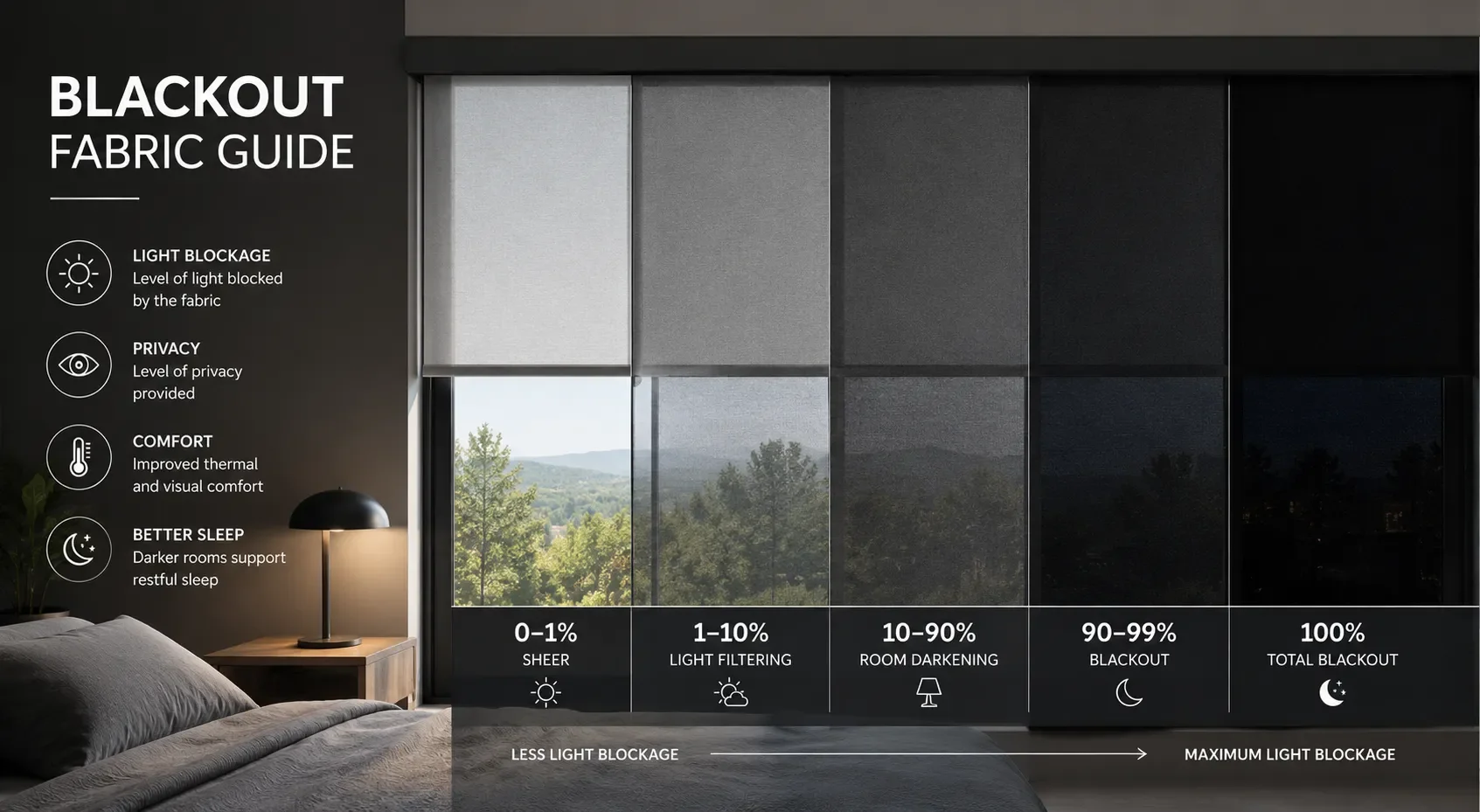
Blackout fabric is one of the most precisely defined categories in the technical textile industry. Unlike solar screen or sunscreen fabrics where performance exists on a spectrum from 1% to 10% openness blackout fabric has a binary definition: it either eliminates light transmission through the fabric body, or it does not.
That clarity in definition does not, however, translate into simplicity in specification. The blackout fabric market spans a wide range of material constructions, application contexts, and performance tiers from basic room-darkening polyester for residential roller blinds to dual-certified fiberglass blackout fabric engineered for motorised outdoor systems in five-star hospitality projects.
This guide explains what blackout fabric actually is, how the indoor and outdoor categories differ, what technical parameters define quality, and how to specify the right blackout fabric for a given project.
What Is Blackout Fabric?
Blackout fabric is a zero openness textile engineered to block light transmission through the fabric body. At 0% openness, there are no gaps in the weave structure every point on the fabric surface is covered by coated yarn or a continuous backing layer.
The result is a fabric that, when correctly installed with appropriate side channels or cassette systems to eliminate light gaps at edges and ends, delivers total or near total light exclusion in the space behind it.
It is important to distinguish between two terms that are sometimes conflated:
Blackout: The fabric body transmits zero or near-zero light. Any residual light in the room comes from installation gaps — edges, sides, top — not through the fabric itself.
Room darkening: The fabric significantly reduces light transmission but does not achieve complete blackout. This category includes low-openness sunscreen fabrics (1–2%) and lighter-weight blackout constructions that may transmit trace light under strong direct sunlight.
For commercial, hospitality, and performance-critical specifications, the distinction matters. A fabric described as "room darkening" should not be specified where genuine blackout is required.
How Blackout Fabric Is Constructed
Coated Blackout Construction
The most common blackout construction in commercial-grade fabrics uses a PVC coated yarn woven at zero openness, with an opaque backing layer that eliminates any residual light transmission through the coating. The backing is typically white or black on white
TepText's Polyester Blackout uses this construction: a PVC coated polyester base fabric engineered for zero light transmission in interior roller blind applications. The polyester core provides flexibility and drape suitable for standard cassette-based roller blind systems.
Fiberglass Blackout Construction
Fiberglass blackout fabric uses a woven glass fiber core the same dimensional stability advantage as fiberglass sunscreen fabric at zero openness. The glass fiber core eliminates thermal expansion, making this the appropriate blackout specification for motorised outdoor systems where the fabric must track precisely through zip channels regardless of temperature.
TepText's Fiberglass Blackout delivers complete light exclusion in the fabric body combined with the dimensional stability and weathering resistance required for outdoor motorised applications. Available in wide-format rolls to 320cm for large-format system installation without seaming.
Acrylic and Foam-Backed Blackout Fabric
Some residential blackout fabrics use a foam or acrylic interlining bonded to a face fabric to achieve light exclusion. These constructions are suitable for curtain and drapery applications but are not appropriate for roller blind systems the bonded construction does not roll cleanly without creasing or delamination over repeated cycles.
Indoor Blackout Fabric: Specification Guide
Indoor blackout fabric for roller blind applications must satisfy several performance criteria beyond simple light exclusion.
Roll Behaviour
The fabric must roll cleanly onto the blind tube without creasing, wrinkling, or delaminating across thousands of deployment and retraction cycles. Coated single layer constructions outperform multi-layer bonded constructions in roller blind applications because the uniform construction rolls consistently without internal layer stress.
Thermal Performance
A blackout fabric at 0% openness blocks all solar energy transmission through the fabric body making it the highest performance solar heat rejection option in the shade fabric range. For interior applications on south and west-facing facades where summer overheating is a concern, blackout is the most effective single fabric solution.
The solar reflectance of the face side matters: a white or light coloured face reflects a significant proportion of solar energy back through the glazing before it can be absorbed. A dark-faced blackout fabric absorbs more energy into the fabric itself, which then re-radiates into the interior space. For heat-critical applications, specify a light faced blackout with high RS value.
Fire Classification
Commercial interior blackout fabric must carry independent fire certification for use in offices, hotels, healthcare facilities, and public buildings. M1 and equivalent certifications indicate the fabric will not sustain combustion when the ignition source is removed.
TepText's Polyester Blackout carries M1 fire certification, making it suitable for commercial interior specification across European and internationally referenced projects.
Aesthetics and Finish
Interior blackout fabrics are available in a range of face finishes smooth, textured, matte, and satin surfaces and colorways. The face is the visible side in the installed position; the backing faces the glazing. For commercial projects, specify the face colorway that complements the interior design intent while noting that lighter faced options deliver better solar reflectance performance.
Outdoor Blackout Fabric: Specification Guide
Outdoor blackout fabric adds a layer of complexity to the specification: in addition to light exclusion and fire performance, the fabric must withstand sustained outdoor UV exposure, rain, wind load, and thermal cycling across years of continuous operation.
Why Outdoor Blackout Is a Different Category
Interior blackout fabrics are not rated for direct outdoor exposure. Their PVC coatings and backing layers are engineered for indoor conditions they will degrade under sustained UV and weathering exposure at a rate incompatible with commercial outdoor system service life expectations.
Outdoor blackout fabric is specifically formulated and tested for weathering resistance. The PVC coating incorporates UV stabilisers that resist photodegradation — maintaining coating integrity, colour stability, and light-blocking performance across 10+ years of outdoor exposure under appropriate conditions.
Dimensional Stability for Motorised Outdoor Systems
The same dimensional stability argument that applies to fiberglass sunscreen fabric in zip guided motorised systems applies with equal force to fiberglass blackout fabric. A motorised outdoor blackout system for a hotel bedroom with floor-to-ceiling glazing, a home cinema media room with external shading, or a commercial space requiring total light control demands a fabric that tracks consistently within its zip channels across all temperatures.
Fiberglass blackout fabric is the only construction that reliably delivers this. The glass fiber core does not expand or contract meaningfully under the temperature swings encountered in outdoor applications, ensuring consistent tracking and preventing the edge wear and operational failures that can occur with polymer core fabrics in precision-guided systems.
Rain Protection
A zero-openness outdoor blackout fabric is also effectively waterproof the PVC coating provides a continuous barrier against water penetration. For outdoor motorised systems on hotel terraces, restaurant facades, or residential outdoor living areas where combined light exclusion and rain protection is the specification, fiberglass blackout fabric addresses both requirements in a single product.
Indoor vs Outdoor Blackout Fabric: Key Differences
| Parameter | Indoor Blackout (Polyester) | Outdoor Blackout (Fiberglass) |
|---|---|---|
| Core material | Polyester | Glass fiber |
| UV weathering resistance | Indoor only | Outdoor rated |
| Dimensional stability | Good | Excellent |
| Zip-system suitability | Limited | Recommended |
| Waterproof | Yes (when installed) | Yes |
| Fire certification | M1 | M1 + NFPA 701 |
| Available widths | Up to 300cm | Up to 320cm |
| Service life (outdoor) | Not rated | 10+ years |
| Roll flexibility | High | Moderate |
| Application | Interior roller blinds | Motorised outdoor systems |
Applications by Sector
Hospitality — Hotels and Resorts
Guest room sleep quality is a direct revenue driver in hospitality. Total light exclusion genuine blackout, not room darkening is a standard guest expectation in premium accommodation. For rooms with external motorised systems (facade integration, retractable outdoor blinds), fiberglass blackout fabric is the correct specification. For interior roller blind systems with cassette channels, polyester blackout fabric with appropriate side-channel installation delivers the required performance at lower system cost.
Healthcare
Clinical environments patient rooms, recovery areas, examination rooms benefit from light controlled conditions at specific times. Blackout fabric in healthcare settings also benefits from the thermal performance of zero openness construction, reducing solar heat gain in rooms that may have limited ventilation or HVAC capacity.
Home Cinema and AV Environments
Media rooms and home cinema spaces require genuine total light exclusion during projection. Interior polyester blackout fabric in a cassette roller blind system, correctly installed with minimal side gaps, achieves this. For dedicated media rooms with external glazing, supplementing with an external fiberglass blackout layer provides belt-and-braces total light exclusion.
Educational Facilities
Classroom and lecture hall blackout is increasingly specified for digital presentation quality. Polyester blackout roller blinds with M1 fire certification meet the standard commercial educational specification.
Residential
For bedrooms particularly those of children, shift workers, or occupants in high latitude locations with long summer daylight hours interior polyester blackout fabric in a well installed roller blind system provides effective daily light exclusion. The key variable in residential blackout performance is installation quality: gaps at edges and ends are responsible for more perceived "blackout failure" than the fabric specification itself.
What to Look for in Blackout Fabric: Specification Checklist
Before specifying any blackout fabric for a commercial project, verify the following:
1. Is it genuinely blackout or room darkening? Ask the supplier to define the product's light transmission under direct sunlight. Genuine blackout fabric transmits zero or near-zero light through the fabric body. Products described as "blackout" that transmit 1–3% light are more accurately room-darkening.
2. Is it rated for the installation environment? Indoor fabrics are not outdoor-rated. Outdoor blackout applications require outdoor-rated fabric with documented weathering resistance.
3. Does it carry appropriate fire certification? M1 (Europe) and NFPA 701 (US/international commercial) are the benchmarks. Request original test certificates, not product description claims.
4. What is the solar reflectance (RS) of the face? For heat sensitive applications, a higher RS value on the face side means more solar energy reflected back through the glazing. Specify a light coloured face for south/west-facing facades in warm climates.
5. What widths are available? For large-format systems, fabric width determines whether seaming is required. TepText's Fiberglass Blackout is available to 320cm eliminating seaming on most single-panel architectural applications.
TepText Blackout Fabric Range
Fiberglass Blackout — Outdoor: Glass fiber core, PVC coated, zero openness. Engineered for motorised outdoor systems — zip-screen, facade-integrated, and retractable outdoor roller blind applications. Dual M1 + NFPA 701 fire certification. UV-stabilised for 10+ year outdoor service life. Available in wide-format rolls to 320cm. Full solar performance data available per colorway. → teptext.com/outdoor-fabrics/fiberglassblackout
Polyester Blackout — Indoor: PVC-coated polyester, zero openness, M1 fire certified. Engineered for interior roller blind systems in residential and commercial applications. Flexible construction for clean roll behaviour across standard cassette and tube diameters. Multiple colorways and face finishes available. → teptext.com/indoorfabrics/polyester-blackout
For technical data sheets, sample requests, or project specification support, contact TepText at info@teptext.com.
Frequently Asked Questions
What is the difference between blackout fabric and room darkening fabric?
Blackout fabric transmits zero or near-zero light through the fabric body at 0% openness. Room darkening fabric significantly reduces light transmission but may transmit 1–3% light visible as a faint glow in strong sunlight conditions. For genuine total light exclusion, specify blackout grade fabric with documented zero light transmission.
Can outdoor blackout fabric also provide waterproofing?
Yes a zero openness outdoor blackout fabric with a continuous PVC coating provides effective rain resistance as well as light exclusion. TepText's Fiberglass Blackout functions as both a blackout and a weatherproofing layer in correctly installed outdoor motorised systems.
What fire certification does commercial blackout fabric require?
For commercial, hospitality, healthcare, and public building applications in Europe, M1 (NF P92-503) is the standard reference. For US and international commercial projects, FR NFPA 701 is required. Both certifications should be documented with original laboratory test certificates.
How wide is blackout fabric available for large-format installations?
TepText's Fiberglass Blackout outdoor fabric is available in widths of 250cm, 300cm, and 320cm designed to eliminate seaming requirements on large single panel architectural installations. Polyester Blackout indoor fabric is available up to 300cm width.
Is blackout fabric suitable for roller blinds in motorised systems?
Yes blackout fabric is widely used in motorised roller blind systems. For interior systems, polyester blackout fabric's flexibility makes it compatible with standard cassette and tube configurations. For motorised outdoor zip screen systems, specify fiberglass blackout fabric for its dimensional stability and outdoor weathering resistance.
