

Shade Fabric for Healthcare Facilities
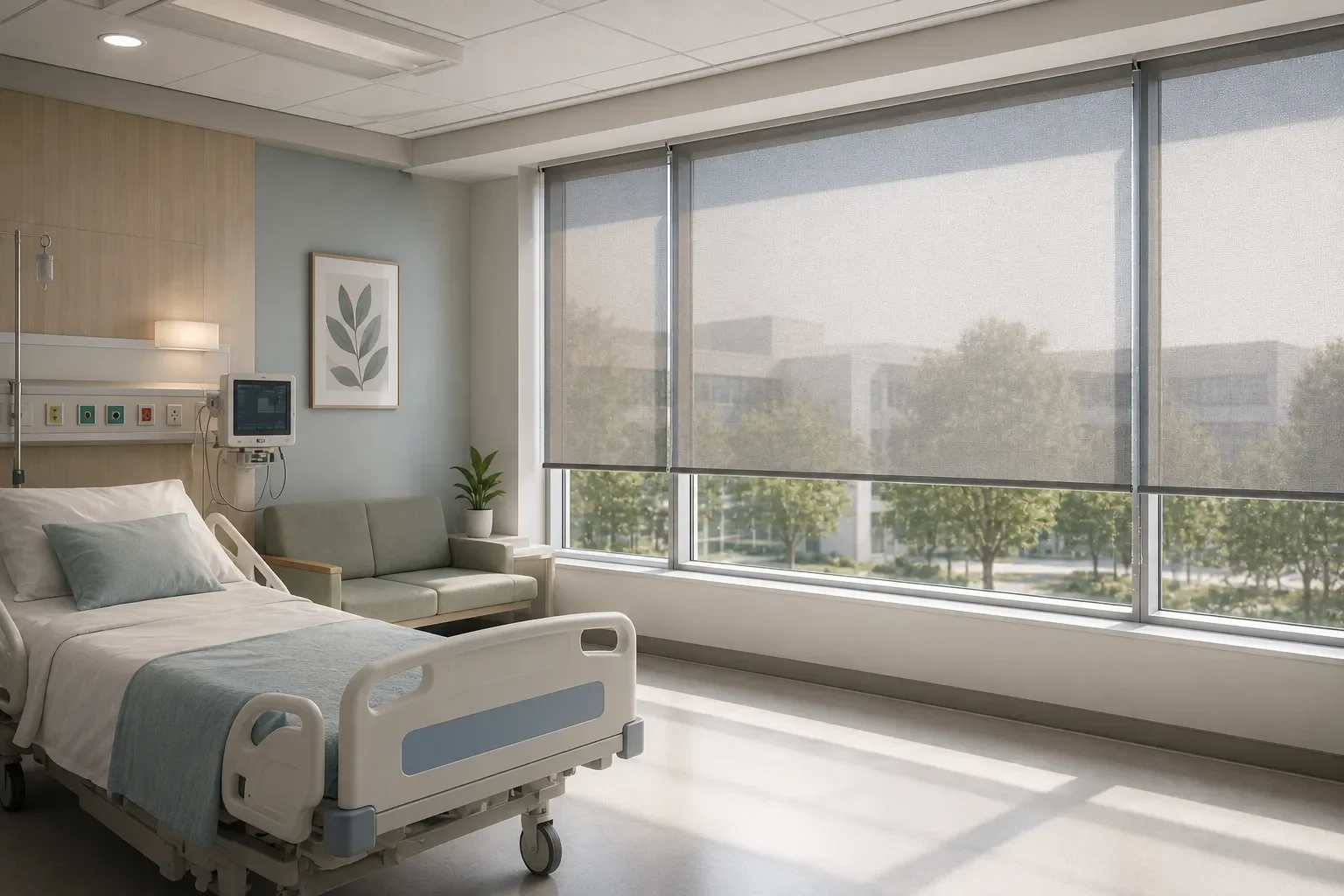
Healthcare projects are among the most demanding environments for shade fabric specification. The requirements that apply in a standard commercial office solar control, glare management, fire certification are all present, and then a further set of clinical, hygiene and operational criteria are layered on top of them.
The result is a specification context where the usual shortcut of choosing fabric from a sample book based on appearance is genuinely inadequate. Hospitals, clinics, care homes and outpatient facilities have specific fabric requirements that are defined by building regulations, infection control standards and clinical workflow needs, not by interior design preferences. This article breaks down what those requirements actually are and how they map to shade fabric selection.
Fire Performance Is Non-Negotiable and Needs Documentation
In any commercial building, fire certified fabric is a requirement. In healthcare, this requirement is enforced with particular rigor because patient populations often have limited mobility and evacuation presents specific challenges. The fabric specification must meet the applicable fire standard for the building, and that standard must be evidenced by documentation not a product description.
The two most widely referenced standards for shade fabric fire performance are M1 under the French NF P92-503 classification and FR NFPA 701, the U.S. National Fire Protection Association standard. Both indicate that a fabric will not sustain combustion after the ignition source is removed. For international healthcare projects or those specifying to European standards, M1 is the relevant certification. For North American or internationally aligned projects, NFPA 701 is required.
What makes healthcare procurement different from standard commercial specification is the level of documentation scrutiny. Project teams need original laboratory test certificates that identify the specific product tested, the test date and the certifying laboratory. A product page that describes a fabric as fire retardant is not documentation. In a healthcare context, particularly for any room classified as a higher risk fire zone, the certificates will be reviewed by the certifying body, and gaps in the documentation chain can hold up project completion.
TepText's fiberglass fabrics carry both M1 and NFPA 701 certifications. Documentation is available on request, which for healthcare projects should be from the outset of specification rather than as an afterthought at project close.
Infection Control and Surface Cleanability
This is where shade fabric specification in healthcare differs most significantly from other sectors. Fabrics in clinical environments must be cleanable with the disinfectants used in that setting. In hospital environments, those disinfectants are often alcohol based, chlorine-based, or quaternary ammonium compounds significantly more aggressive than the mild detergents appropriate for most commercial fabric maintenance.
PVC-coated technical fabrics both fiberglass core and polyester core have a sealed surface that resists liquid penetration and can be wiped down with clinical disinfectants without degrading the coating or compromising the fabric's solar performance characteristics. This is a meaningful practical advantage over fabric types with open textile surfaces, which absorb cleaning agents and can harbor contamination in their weave structure.
The other relevant factor is resistance to mold and mildew. Healthcare facilities in humid climates, or in areas with high condensation on glazing, need fabrics that do not support microbial growth. PVC shade fabrics are inherently resistant to mold and mildew because the sealed coating surface does not provide a substrate for growth in the way that open-weave or porous textiles do.
For clinical areas with the highest hygiene requirements operating theatres, intensive care units, isolation rooms the question of antimicrobial treatment is sometimes raised. Some fabric manufacturers offer fabrics with incorporated antimicrobial agents. For most healthcare shade fabric applications, however, the key specification criterion is cleanability with clinical disinfectants rather than inherent antimicrobial properties, and PVC coated technical fabrics meet this criterion without requiring specialist treatment.
Light Control Across Different Clinical Zones
Healthcare facilities are not a single light control environment. Patient rooms, diagnostic imaging suites, outpatient clinics, staff offices and public circulation areas all have different light control requirements, and a single fabric specification applied uniformly across a building will satisfy none of them well.
Patient rooms benefit from solar screen fabric during the day controlling glare and solar heat gain while preserving natural light, which has well documented positive effects on patient recovery and wellbeing. At night, or when patient rest is required, a blackout layer is needed. A typical specification for patient rooms is a dual system: a solar screen fabric for daytime use and a blackout blind for sleep and clinical examination. Both layers need fire certification, both need cleanable surfaces, and the blackout layer needs to achieve genuine light exclusion rather than a partial room-darkening effect.
Diagnostic imaging rooms X-ray, MRI, CT scanning suites require complete light control and typically specify blackout at 100% of windows. The fabric choice here is driven by the need to maintain controlled lighting conditions for accurate diagnostic imaging. TepText's Polyester Blackout is appropriate for interior installations in these contexts; Fiberglass Blackout is the specification for any externally mounted system.
Outpatient consultation rooms prioritize privacy during the day. A lower openness factor 1% to 3% provides the visual separation between the consultation space and external views while maintaining some natural light. For ground-floor rooms facing street level or car parks, the fabric specification should account for the need to prevent view-in from passing pedestrians or vehicles, which means selecting a colorway with sufficient opacity in the yarn rather than relying on openness factor alone.
ICU and high-dependency environments typically run 24 hours, with clinical lighting controlled independently of natural light. In these areas, solar screen fabric contributes to glare management and thermal comfort for staff and patients, but the primary specification driver is often the ability to integrate the system with the room's controlled environment rather than light control per se.
Thermal Comfort in Clinical Environments
Thermal comfort in healthcare settings is not simply a matter of occupant preference. Clinical staff need to work effectively over long shifts, and temperature variation caused by solar heat gain through large glazing panels directly affects their working environment. Patients particularly post-operative patients, the elderly, or those with compromised thermoregulation are more sensitive to radiant heat from sun-exposed windows than a healthy adult in an office would be.
Specifying shade fabrics with high Solar Reflectance on south and west-facing facades reduces the radiant heat load on occupants adjacent to glazing. In a patient room with a bed positioned near a large window, the difference between an unshaded window and one with a properly specified solar screen fabric can be the difference between comfortable and clinically problematic conditions on a summer afternoon.
For this reason, the Solar Transmittance and Solar Reflectance values of the specified fabric should be reviewed for each facade orientation, not simply specified uniformly across the building. Lighter colorways with higher Solar Reflectance are generally preferred on south and west-facing patient room windows in warm climates; the visual transmittance of these colorways also supports the daylighting benefit that clinical research consistently associates with positive patient outcomes.
Motorised Systems and Clinical Workflow
Manual blinds in clinical environments create infection control complications that are sometimes overlooked at specification stage. Every manual operation involves touching the blind mechanism, which in a clinical setting means either hand hygiene before and after every adjustment or accepting that the mechanism is a potential cross contamination point.
Motorised systems eliminate this issue. A bedside or nursing station control for the window shade avoids direct patient or staff contact with the mechanism entirely. For isolation rooms or areas with particularly strict infection control protocols, motorised operation is not a preference but a hygiene specification.
The fabric specification for a motorised healthcare system follows the same technical criteria as any other motorised system: fiberglass core fabric for large format or zip guided external systems, polyester-core for standard interior casette roller systems. The additional healthcare requirement is that the motor housing and mounting hardware must also be cleanable with clinical disinfectants this is a system specification, not a fabric-only consideration, but it is worth raising with the system supplier at the outset.
A Practical Specification Framework
For architects and project managers working on healthcare shade fabric specification, the following framework covers the key decision points:
Start with the fire certification requirement for the specific building classification and jurisdiction. Confirm that the fabric carries the required certification and that original test documentation is available.
Define the light control requirement for each room type. Patient rooms typically need a dual solar screen and blackout specification. Imaging suites need full blackout. Outpatient rooms need privacy level solar screen. ICU areas need glare control with cleanability as the primary additional criterion.
Specify the solar performance requirements for each facade orientation. South and west-facing windows need higher Solar Reflectance values than north or east facing windows.
Confirm that the fabric surface is compatible with the cleaning protocols used in the facility. For PVC coated technical fabrics this is generally straightforward, but it is worth confirming with the manufacturer for any specialist cleaning agents used in high risk clinical areas.
Consider motorised systems for any area with strict infection control requirements, and specify the control interface at the same time as the fabric.
TepText supplies fiberglass and polyester shade fabrics suitable for healthcare specification, with full fire certification documentation and per-colorway solar performance data. For project-specific support, contact info@teptext.com.
