

How Solar Screen Fabric Contributes to LEED Certification
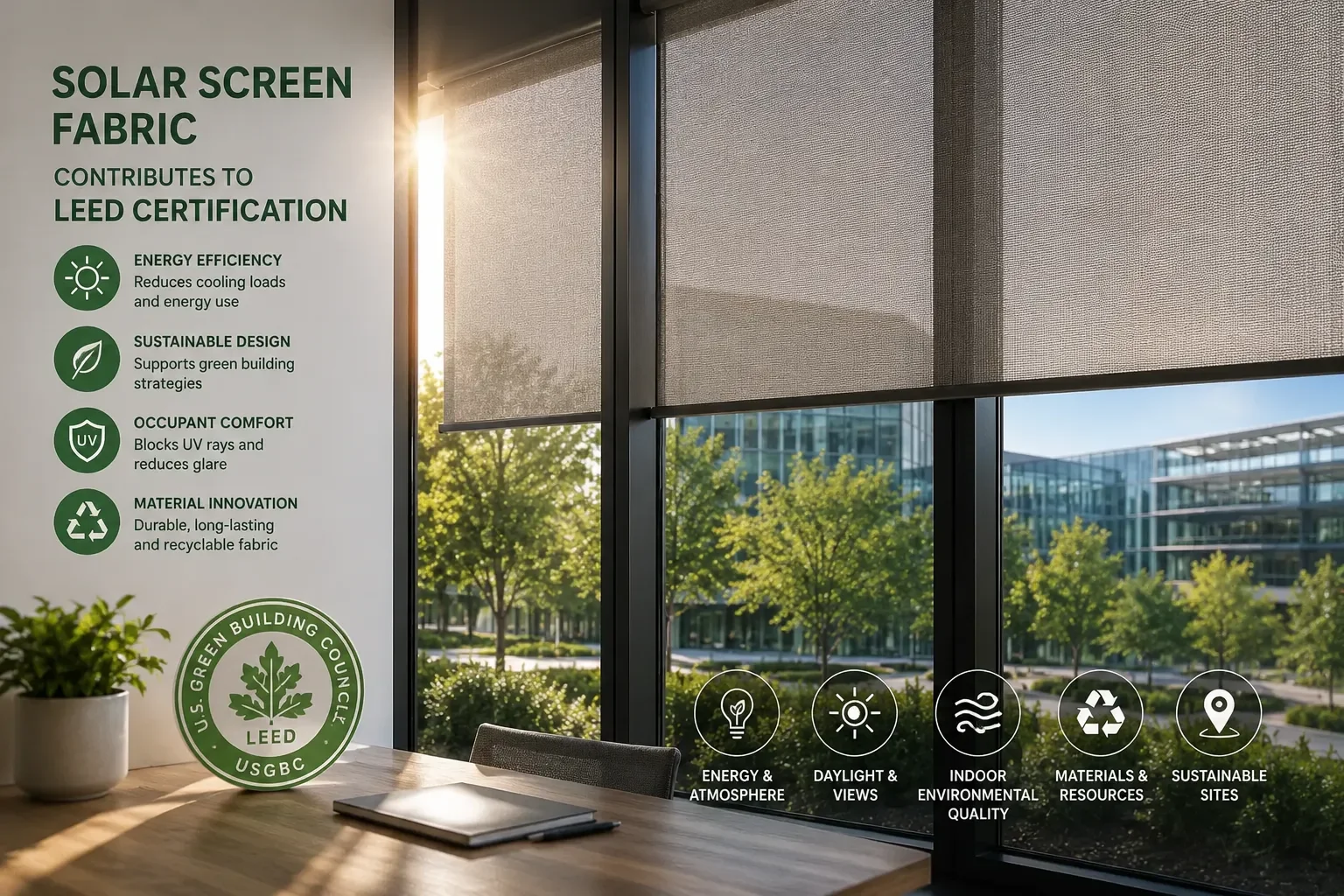
Green building is no longer a niche pursuit. Across commercial real estate, healthcare, education and hospitality, LEED certification has become a baseline expectation rather than a differentiator. And while most conversations about LEED points focus on mechanical systems, glazing performance or renewable energy, window treatment fabric is quietly one of the more accessible contributors to a building's certification score provided the right products are specified from the start.
This article is written for architects, project managers and procurement teams who want to understand exactly where solar screen fabric fits into the LEED framework, and what to look for when selecting fabrics with certification in mind.
What LEED Is Actually Measuring
LEED, developed by the U.S. Green Building Council, evaluates buildings across several performance categories: energy efficiency, indoor environmental quality, materials and resources, sustainable sites, water use, and innovation. Points are awarded across these categories, and the total score determines certification level: Certified, Silver, Gold or Platinum.
Solar screen and blackout fabrics can contribute meaningfully to points in three of these categories. None of them work in isolation the fabric is part of a broader system but in each case, the fabric specification directly influences whether that contribution is real or theoretical.
Energy and Atmosphere: Where the Numbers Are Largest
The most significant LEED contribution from shade fabric comes through energy performance. Solar screen fabric reduces the amount of solar heat entering a building through glazing a metric captured in the Solar Heat Gain Coefficient of the overall window assembly. Lower heat gain means less work for the cooling system, and less cooling load means lower energy consumption.
For projects targeting points under the Energy and Atmosphere category, the shade fabric specification needs to be backed by real solar performance data. This means the fabric supplier should be able to provide Solar Transmittance, Solar Reflectance and Solar Absorption values per colorway, not just a general UV blockage percentage. The reason colorway matters is simple: a white fabric and a charcoal fabric of identical openness factor have very different solar heat management profiles. A white fabric with high Solar Reflectance sends heat back through the glazing before it enters the space. A dark fabric with high Solar Absorption holds that heat in the fabric itself and re radiates it inward.
For facades with significant solar exposure, particularly south and west orientations in warm climates, the difference between a correctly specified and an incorrectly specified colorway can represent a meaningful shift in cooling load. That shift affects the energy model, which affects the LEED score.
Fiberglass sunscreen fabrics with full per colorway performance documentation are the most straightforward to use in energy modeling contexts, because the data is precise enough to be useful. Products where the supplier can only offer product-level averages are harder to work with in formal performance calculations.
Indoor Environmental Quality: Daylighting and Views
LEED's Indoor Environmental Quality category includes credits for daylighting and quality views. Both are affected by shade fabric specification.
Daylighting credits reward designs that bring natural light into occupied spaces without creating glare or thermal discomfort. A solar screen fabric with the right Visual Transmittance value allows daylight to enter while controlling direct sun and glare maintaining the daylighting benefit without the discomfort that unshaded direct sun creates.
The tension in this calculation is real: lower openness factor means better glare and heat control but less natural light; higher openness means more daylight but less control. The LEED credit rewards spaces where daylight levels are maintained within a usable range, so an extremely low openness specification that cuts daylight excessively can actually work against this credit even while benefiting the energy credit.
This is why per colorway Visual Transmittance data matters. A 5% openness white fabric may transmit 21% of visible light; the same 5% openness in charcoal may transmit only 5%. These are very different daylighting outcomes from the same nominal specification.
The views credit rewards designs that maintain a direct line of sight to the outdoors for occupants. Solar screen fabric at 5% openness preserves view-through during daylight hours something blackout specification does not. For spaces where both solar control and maintained views are design objectives, solar screen is the specification that enables both credits simultaneously.
Materials and Resources: Certifications That Count
The third area where shade fabric contributes to LEED is through the materials and resources credits. These reward products that meet specific environmental and health standards in their manufacturing and composition.
Relevant certifications for solar screen fabric include:
GREENGUARD Gold certification indicates that a product has been tested for chemical emissions and meets strict thresholds for volatile organic compounds. This is particularly relevant for interior fabric applications in healthcare and educational buildings, where indoor air quality standards are more stringent.
Cradle to Cradle certification evaluates materials against a circular economy framework considering recyclability, manufacturing process environmental impact, and end of life treatment. PVC free polyester fabric options are increasingly available for projects where material chemistry is a key specification criterion.
Recycled content in the fabric or packaging can contribute to materials credits depending on the project's regional priority credits and the specifics of the certification pathway chosen.
It is worth being direct about one thing: fire certification is not a LEED credit. M1 and NFPA 701 are safety requirements, not sustainability ones. They matter enormously for building compliance but should not be conflated with the environmental certifications that drive LEED points.
Automated Shading and Demand Response
An area that is growing in relevance for LEED projects is automated shading integrated with building management systems. LEED's Energy and Atmosphere category includes credits for demand response capability, and motorised shade systems that adjust automatically based on solar position, occupancy and grid signals contribute to this.
The fabric specification does not change based on whether the system is motorised or manual, but for projects where motorised systems are being installed, the combination of a correctly specified fiberglass sunscreen fabric and an automated control system creates a more compelling energy case than either element alone. Fiberglass is the appropriate fabric choice for motorised outdoor systems specifically because its dimensional stability ensures the system operates correctly across temperature ranges, year after year preserving the energy performance benefit that justified the installation in the first place.
What to Ask When Specifying for LEED Projects
If you are specifying shade fabric for a LEED project, these are the questions that actually move the needle:
Can the supplier provide per colorway solar performance data in a format compatible with energy modeling software? Some suppliers provide data that is compatible with ASHRAE calculations; others provide marketing-grade summaries that cannot be used in formal energy analysis.
Does the fabric carry GREENGUARD Gold or equivalent low emission certification? This is most relevant for healthcare and educational applications but is increasingly standard in commercial projects.
Is the product available in PVC free formulations? For projects targeting specific materials credits or with restrictions on PVC use, this may be a mandatory specification criterion rather than a preference.
Can the supplier provide documentation for all certifications claimed? In a LEED project, the certifications need to be documented for the project team's submission. A supplier who cannot provide original test certificates is not useful in a certification context, regardless of what is stated on a product page.
Putting It Together
Solar screen fabric is not a primary driver of LEED certification on its own. A building earns LEED points through a system of integrated decisions across many product categories. But in the right project context, a correctly specified shade fabric contributes meaningfully to three credit categories, and a poorly specified one can limit the building's ability to earn credits that the glazing, HVAC and lighting design otherwise make possible.
The practical takeaway for specifiers is straightforward: treat shade fabric as a technical specification rather than a procurement afterthought. Request solar performance data by colorway, verify environmental certifications with documentation, and integrate the fabric specification into the energy model early enough for the numbers to actually influence design decisions.
TepText supplies fiberglass sunscreen and blackout fabrics with full per-colorway technical documentation. For project specification support or data requests, contact the team at info@teptext.com.
