

Fiberglass vs PVC Sunscreen Fabric
Fiberglass sunscreen fabric and PVC-coated polyester sunscreen fabric are the two dominant material technologies in the architectural solar shading industry. They look similar on a sample card. They perform similarly on a basic UV blockage data sheet. But in real-world installation conditions large format motorised systems, precision zip screens, extended outdoor exposure they behave very differently.
Choosing between them is not a matter of preference. It is a technical specification decision with direct consequences for system performance, installation quality, and long term durability. This guide gives you the framework to make that decision on the right grounds.
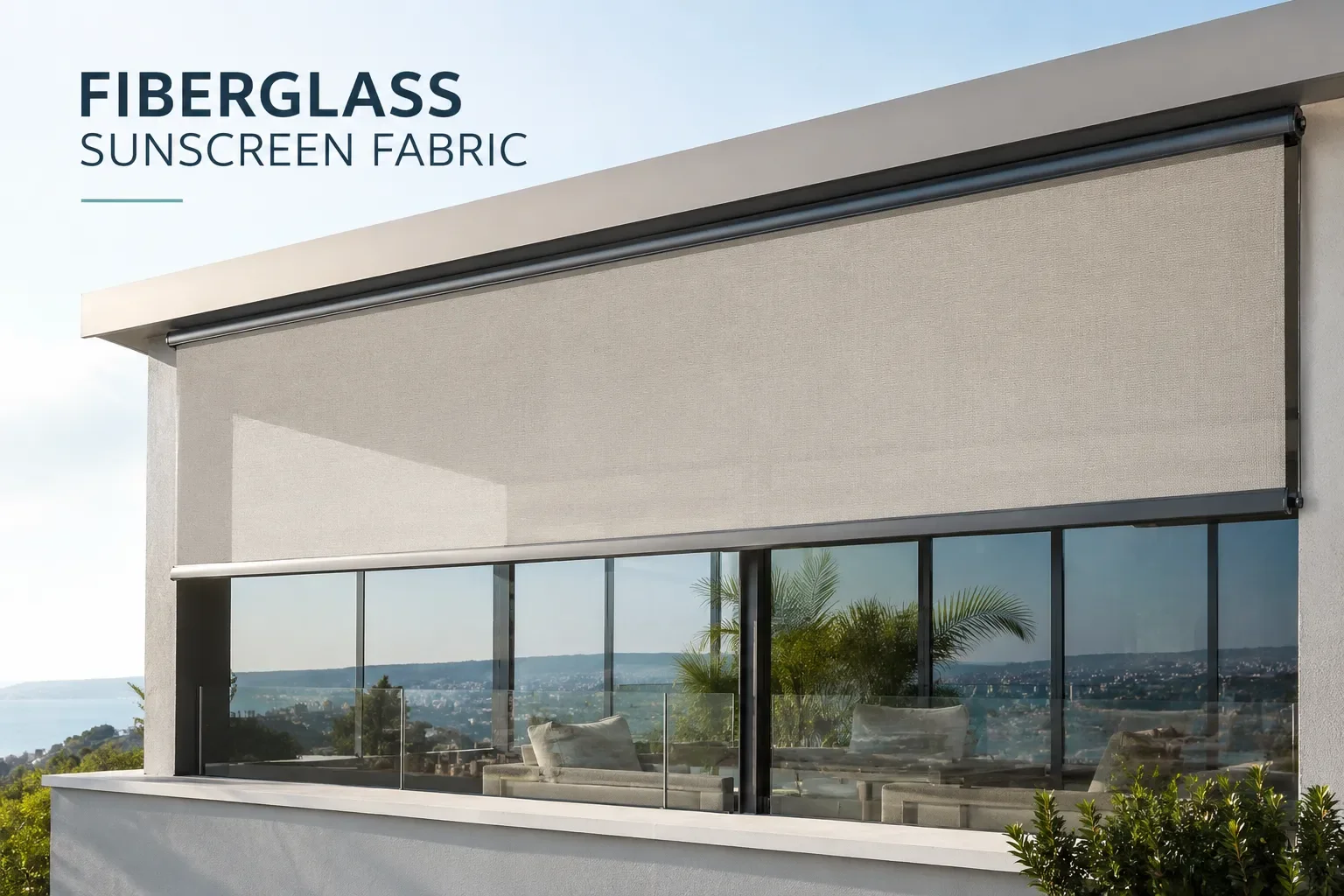
What Is Fiberglass Sunscreen Fabric?
Fiberglass sunscreen fabric uses woven glass fiber yarn as its structural core, coated with UV stabilised PVC. The glass fiber provides the fabric's defining characteristic: near zero thermal expansion. The fabric does not stretch or contract meaningfully as temperatures cycle a property that sets it apart from every polymer-based alternative.
The PVC coating delivers UV blockage, solar reflectance, weathering resistance, and fire performance. Combined with the glass fiber core, the result is a fabric that maintains its geometry, its tracking accuracy, and its solar control performance across years of deployment and retraction in motorised systems.
Core construction: 65–70% PVC / 30–35% fiberglass (varies by series)
Typical thickness: 0.70–0.75mm
Weight: 540–560 g/m²
UV blockage: ~97% across all colorways
Fire certification: M1 (NF P92-503) + FR NFPA 701
Available widths: up to 320cm
What Is PVC/Poly Sunscreen Fabric?
PVC-coated polyester sunscreen fabric uses a woven polyester yarn base coated with PVC. Polyester is a polymer it has a measurably higher coefficient of thermal expansion than glass fiber. Under heat, it expands; under cold, it contracts. For most roller blind applications, this thermal movement is managed within acceptable tolerances. For large-format precision systems, it becomes a specification-critical variable.
PVC/poly sunscreen fabric is softer, more flexible, and easier to handle than fiberglass. It suits a broader range of system formats particularly indoor roller blinds, smaller format manual systems, and applications where the mechanical demands of motorised zip-guided tracking are not present.
Core construction: PVC-coated woven polyester
Typical thickness: 0.50–0.65mm (varies by product)
UV blockage: ~95–97%
Fire certification: M1 / equivalent (product-dependent)
Available widths: typically up to 300cm
The Critical Difference - Dimensional Stability
This is where the specification decision becomes clear for most professional applications.
Glass fiber has a coefficient of thermal expansion (CTE) approximately five times lower than polyester. In practical terms: a 3-metre wide fiberglass sunscreen fabric panel will expand by a fraction of a millimetre across a 60°C temperature swing. The same panel in PVC/poly may expand by several millimetres.
In a free-hanging roller blind or a small-format manual system, this difference is inconsequential the fabric hangs freely and accommodates the movement without issue.
In a zip guided motorised system where the fabric edges are constrained within aluminium channels and must track accurately through the zip mechanism across every deployment and retraction cycle dimensional stability is a mechanical requirement, not a preference. Fiberglass sunscreen fabric was developed specifically to meet this requirement.
When dimensional stability is critical:
Zip-screen motorised systems (any span)
Large-format roller blinds (spans over 3m)
Facade-integrated shading systems with tight cassette tolerances
Any system where fabric tracking accuracy determines product warranty compliance
When PVC/poly performs well:
Interior roller blind systems (residential and commercial)
Manual blind applications
Smaller-format motorised systems without zip guidance
Applications where fabric flexibility is required for compact roll diameter
Solar Performance, Are They Really Different?
On UV blockage and broad solar performance, high-quality fiberglass and PVC/poly sunscreen fabrics are comparable. Both achieve approximately 95–97% UV blockage. Both are available in the 1–10% openness factor range. Both deliver meaningful solar heat reduction through the glazing plane.
The nuances emerge in:
Long-term outdoor weathering: Fiberglass-core fabrics maintain their geometry and coating integrity under sustained outdoor UV and thermal cycling more consistently than PVC/poly. The glass fiber core does not fatigue under repeated stress cycles the way polyester yarn does over an extended service life.
Roll diameter: At equal thickness, fiberglass sunscreen fabric produces a slightly larger roll diameter for the same fabric length. This is relevant for cassette and fascia sizing in motorised system design — particularly where compact cassettes are specified.
Drape and hand: PVC/poly has a softer, more flexible hand. In interior applications where the fabric is visible close-up, this can be an aesthetic preference. In exterior applications where performance under load and weather matters, the fiberglass core's rigidity is an advantage.
Fire Performance
Both fiberglass and PVC/poly sunscreen fabrics from credible technical manufacturers carry independent fire certifications — typically M1 (NF P92-503) and FR NFPA 701.
M1 certification indicates the fabric is flame-retardant: it will not sustain combustion when the ignition source is removed. NFPA 701 is the equivalent US standard. Together, these two certifications cover the broadest range of commercial, hospitality, and public building specifications globally.
For any project with a fire engineering specification commercial offices, hotels, hospitals, educational buildings, retail verify that the certification documents are available from the supplier. A product described as "fire retardant" without supporting test documentation is not a compliant specification.
TepText's Fiberglass Sunscreen (both 4000FR and 6000FR Series) and PVC/Poly Sunscreen carry M1 and NFPA 701 certifications, with documentation available on request.
| Specification | Fiberglass Sunscreen | PVC/Poly Sunscreen |
|---|---|---|
| Core material | Glass fiber | Polyester |
| Thermal expansion | Near-zero | Moderate |
| UV blockage | ~97% | 95–97% |
| Openness factor range | 1–10% | 1–10% |
| Fire certification | M1 + NFPA 701 | M1 + NFPA 701 |
| Max width | 320cm | 300cm |
| Zip system suitability | Excellent | Limited |
| Large-format motorised | Recommended | Not recommended |
| Indoor roller blind | Suitable | Preferred |
| Fabric flexibility | Moderate | High |
| Service life (outdoor) | 10+ years | 8–12 years |
| Typical weight | 540–560 g/m² | 400–500 g/m² |
Which to Specify: Decision Framework
Specify fiberglass sunscreen fabric when:
The system is motorised and zip-guided
The fabric span exceeds 3 metres
The installation is external or semi-external
Dimensional stability across temperature cycling is a system requirement
Wide-format rolls (300–320cm) are needed to eliminate seaming
Long service life under outdoor exposure is a project KPI
Specify PVC/poly sunscreen fabric when:
The system is an interior roller blind (residential or commercial)
The format is manual or small-format motorised without zip guidance
Compact roll diameter is a cassette constraint
Fabric flexibility and softer hand are installation requirements
Budget efficiency is a priority alongside performance
TepText Sunscreen Fabric Portfolio
TepText supplies both fiberglass-core and PVC/poly sunscreen fabrics, each engineered for their respective application domains.
Fiberglass Sunscreen — Outdoor Series: Available in two series — 6000FR (70% PVC / 30% fiberglass) and 4000FR (65% PVC / 35% fiberglass). Six colorways from white-beige to black, with full per-colorway solar data (TS/RS/AS/TV). 5% openness factor. M1 + NFPA 701 dual certification. Widths: 250cm, 300cm, 320cm. Standard pack: 30m rolls.
PVC/Poly Sunscreen — Indoor Series: PVC-coated polyester construction for interior roller blind and solar shading applications. Available in multiple openness factors and colorways. Suitable for residential and commercial interior specification.
For technical data sheets, sample requests, or system-specific fabric selection guidance, contact TepText at info@teptext.com or visit teptext.com/outdoor-fabrics and teptext.com/indoorfabrics.
Frequently Asked Questions
Can fiberglass sunscreen fabric be used indoors?
Yes fiberglass sunscreen fabric is technically suitable for interior applications, but its stiffer hand and higher weight per square metre make PVC/poly the more practical specification for standard interior roller blind systems. Fiberglass is the appropriate choice where an interior system has large spans, motorised zip guidance, or precision tracking requirements.
Is fiberglass sunscreen fabric more expensive than PVC/poly?
Fiberglass-core sunscreen fabric is typically priced above PVC/poly of comparable openness and certification. The premium reflects the more complex manufacturing process and the superior dimensional stability of the glass fiber core. For systems where fiberglass is the appropriate technical specification, the performance differential justifies the price difference across the system's service life.
What openness factor is standard for commercial fiberglass sunscreen fabric?
5% openness is the most widely specified option for commercial and architectural applications balancing solar heat rejection, glare control, UV protection, and outward view-through. 1–3% openness is available for privacy-critical applications; 10% is available where higher transparency and natural daylighting are prioritised.
Does fiberglass sunscreen fabric require special handling during installation?
Fiberglass sunscreen fabric should be handled with appropriate care to avoid sharp bends or kinking the glass fiber core can be damaged by extreme localised flexing. Standard roller blind installation practices are appropriate; the fabric should not be folded or creased along its length during handling.
