

Retractable Awning Material - How to Choose the Right Fabric for Your System
Retractable awning systems are among the most mechanically demanding applications for outdoor shade fabric. The fabric deploys and retracts sometimes hundreds of times per year under UV exposure, wind load, rain, and temperature cycling. It must roll cleanly at every cycle, track accurately in its guides, and maintain its solar control performance across a service life measured in years, not months.
The retractable awning material that goes into this system is not a commodity purchase. Specify the wrong fabric one that stretches under thermal load, degrades under UV exposure, or fails to track within its channels and the system fails long before the frame or motor does.
This guide covers what to look for in retractable awning fabric, why material construction is the decisive variable, and how to match the right fabric specification to the mechanical and environmental demands of the system.
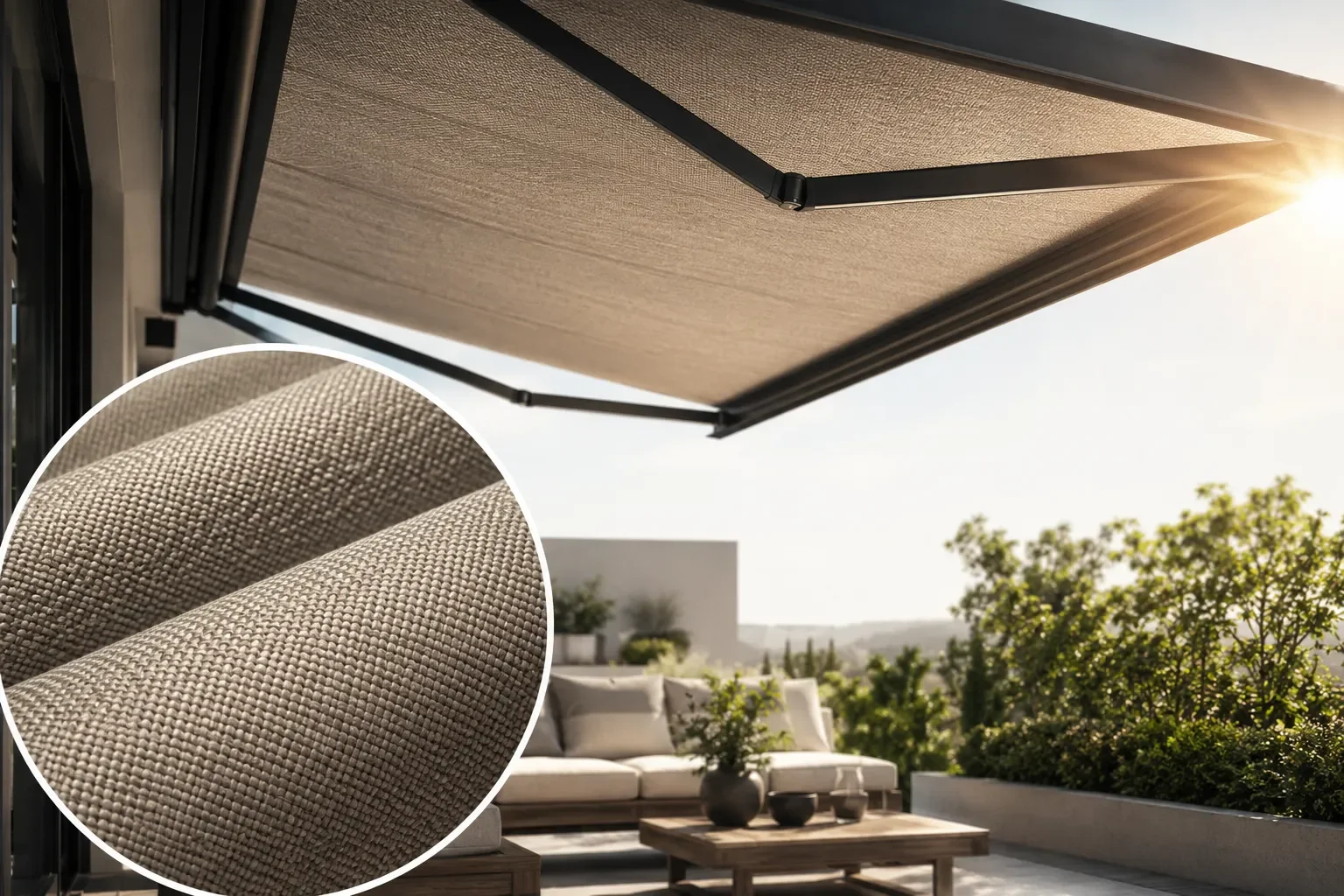
What Makes Retractable Awning Fabric Different
Standard shade fabrics used in fixed or lightly tensioned applications tolerate dimensional movement if the fabric expands slightly in summer heat, nothing breaks. In a retractable awning system, particularly a motorised zip guided system, the tolerances are far tighter.
The fabric must:
Track consistently in zip channels. Zip-guided retractable systems hold the fabric edges within aluminium channels as the blind extends and retracts. If the fabric expands under heat, the edges push against the channel walls creating friction, wear, and eventually tracking failure. If it contracts in cold, the edges can pull away from the zip, losing the guided seal and reducing the system's wind resistance.
Roll cleanly on every cycle. The fabric must form a uniform, wrinkle free roll on the tube at every retraction. Fabrics that distort under thermal stress or develop creases under sustained tension do not roll cleanly reducing the system's operational reliability and aesthetic quality over time.
Resist UV degradation. Outdoor retractable systems expose the fabric to sustained direct UV radiation. The PVC coating must maintain its integrity no chalking, cracking, or colour shift across years of this exposure.
Maintain solar control performance. Retractable awning material that degrades under UV loses not just its appearance but its performance UV blockage, solar transmittance, and reflectance values shift as the coating deteriorates.
The material construction that satisfies all four requirements is fiberglass-core coated fabric specifically, a woven glass fiber yarn base with UV stabilised PVC coating.
Fiberglass - The Engineering Case
The glass fiber yarn at the core of fiberglass retractable awning fabric has a coefficient of thermal expansion approximately five times lower than polyester. In real-world terms, across a temperature swing from -5°C to +60°C common in southern European or Middle Eastern outdoor installation conditions a fiberglass fabric panel of 3 metres width will expand by a fraction of a millimetre. The equivalent panel in PVC-coated polyester will expand by several millimetres.
Several millimetres of expansion across a 3 metre zip guided channel is the difference between consistent performance and progressive tracking failure. It is also the difference between a system that operates for ten years and one that begins showing edge wear, zip channel damage, and operational problems within three to five seasons.
Fiberglass retractable awning material also maintains its flat geometry under sustained tension. Polyester yarn creeps under long-term tensile load a phenomenon that causes gradual fabric distortion in permanently deployed or semi-permanent installations. Glass fiber does not creep measurably under the tension loads encountered in retractable awning systems.
TepText'sFiberglass Sunscreen and Fiberglass Blackout outdoor ranges are engineered specifically for this application context. The 6000FR Series (70% PVC / 30% fiberglass) and 4000FR Series (65% PVC / 35% fiberglass) represent two construction profiles both delivering the dimensional stability required for motorised retractable systems, with the 4000FR offering slightly higher glass fiber content for maximum rigidity in large span applications.
Solar Performance in Retractable Awning Fabric
For sunscreen retractable awning material where solar control rather than total blackout is the specification — openness factor and colorway are the two variables that drive performance.
Openness Factor for Retractable Systems
5% openness is the standard specification for commercial retractable awning systems. It provides:
Effective solar heat rejection. Solar Transmittance typically 6–20% depending on colorway
~97% UV blockage through the coated yarn
Maintained outward view through occupants can see the exterior environment while protected from direct sun and glare
Wind resistance adequate for motorised systems up to standard design wind speeds
For retractable systems in locations with exceptionally high insolation desert climates, high altitude installations, equatorial latitudes a 3% openness specification provides additional solar heat rejection at the cost of reduced view-through transparency.
Colorway and Heat Management
The colorway of retractable awning fabric has a larger impact on interior thermal comfort than openness factor alone. The key metric is Solar Reflectance the proportion of total solar energy reflected back by the fabric surface before it can enter the space.
Light-coloured fabrics in TepText's Fiberglass Sunscreen range achieve RS values above 50% reflecting more than half of total incident solar energy. Dark fabrics absorb significantly more energy into the fabric surface, which then re-radiates into the space below.
For retractable awning material on south and west-facing facades in warm climates where the primary objective is reducing cooling load and occupant heat stress specify a light-coloured high-RS fabric. For systems where glare elimination is the priority and heat management is secondary, darker fabrics provide superior glare control at a thermal performance trade-off.
Per-colorway performance data should be requested from any supplier before final colorway selection for a project specification.
When to Specify Blackout Retractable Awning Material
Not all retractable outdoor systems are solar screen applications. For motorised outdoor blinds serving:
Hotel and serviced apartment bedroom facades
Home cinema rooms with external glazing
Healthcare patient rooms requiring light-controlled environments
Residential bedrooms in high-latitude locations with extended summer daylight total light exclusion is the specification objective, and zero-openness fiberglass blackout fabric is the correct retractable awning material.
TepText's Fiberglass Blackout outdoor range delivers zero light transmission through the fabric body with the same dimensional stability characteristics as the sunscreen series glass fiber core, UV-stabilised PVC coating, M1 + NFPA 701 fire certification, and wide-format roll availability to 320cm.
The zero-openness construction of fiberglass blackout material also provides effective rain resistance — a combined blackout and weather protection specification in a single fabric layer for correctly installed motorised systems.
Roll Width and Seam Placement
For large format retractable awning installations facade integrated systems, wide-span pergola motors, hotel balcony systems roll width determines whether seaming is required within the fabric panel.
Seams in retractable awning fabric are weak points: adhesion between panels can degrade under repeated thermal cycling and mechanical stress, seams create visual lines visible from both sides of the fabric, and the double layer at the seam creates a thicker band that can affect roll formation on narrow-diameter tubes.
TepText's outdoor fiberglass fabrics are available in widths of 250cm, 300cm, and 320cm specifically to eliminate or minimise seaming requirements on large format retractable systems. For single-panel installations up to 320cm wide, a seamless specification is achievable.
For systems wider than 320cm, seaming is unavoidable, and seam specification adhesive type, seam geometry, seam placement relative to the view line should be addressed at the fabric specification stage rather than left to installation practice.
Fire Certification for Motorised Outdoor Retractable Systems
Commercial retractable awning systems hotel facades, restaurant terraces, office building external shading, retail canopies require fire-certified fabric. The applicable standards depend on the project location and specification:
M1 (NF P92-503): French standard, widely referenced in European commercial specifications. Indicates the fabric will not sustain combustion.
FR NFPA 701: US standard, increasingly referenced in international commercial and hospitality projects.
TepText's Fiberglass Sunscreen and Fiberglass Blackout outdoor ranges carry both certifications the broadest coverage for international commercial specification. Original test certificates are available on request: always verify documentation rather than relying on product description claims.
Retractable Awning Material Specification Summary
| Requirement | Recommended Material |
|---|---|
| Motorised zip-guided system | Fiberglass sunscreen or blackout |
| Large span (3m+) | Fiberglass — dimensional stability essential |
| Solar control + view-through | Fiberglass Sunscreen, 5% OF |
| Total light exclusion (outdoor) | Fiberglass Blackout |
| Heat-critical south/west facade | Light colorway, high RS value |
| Glare elimination priority | Dark colorway, low TV |
| Commercial / fire code required | M1 + NFPA 701 certified |
| Seamless wide-format panel | Widths to 320cm available |
| Residential small-format system | PVC/poly sunscreen acceptable |
TepText Retractable Awning Fabric Portfolio
Fiberglass Sunscreen — Outdoor (4000FR / 6000FR Series): 5% openness, ~97% UV blockage, M1 + NFPA 701. Six colorways with full per-colorway solar data. Widths: 250, 300, 320cm. 30m standard rolls. Engineered for motorised zip-guided retractable systems. → teptext.com/outdoor-fabrics/fiberglasssunscreen
Fiberglass Blackout — Outdoor: 0% openness, total light exclusion, waterproof, M1 + NFPA 701. Wide-format availability to 320cm. Suitable for motorised blackout retractable systems in hospitality, residential, and commercial applications. → teptext.com/outdoor-fabrics/fiberglassblackout
For project specification support, technical data sheets, or sample requests, contact TepText at info@teptext.com.
Frequently Asked Questions
What is the best fabric for a motorised retractable awning system?
Fiberglass-core coated fabric is the engineering benchmark for motorised retractable systems particularly zip guided configurations. Its near-zero thermal expansion eliminates the tracking issues that polymer core fabrics develop under temperature cycling. For solar control applications, fiberglass sunscreen at 5% openness; for total light exclusion, fiberglass blackout.
Can I use standard outdoor fabric for a retractable system?
Not all outdoor fabrics are suitable for retractable systems. The fabric must be rated for the mechanical demands of repeated deployment and retraction, dimensional stability under thermal cycling, and compatible roll behaviour with the tube and cassette specification. Always verify the fabric supplier's recommendation for motorised retractable applications specifically.
How often does retractable awning fabric need to be replaced?
Quality fiberglass retractable awning material in a well-maintained system maintains its performance for 10+ years under normal outdoor exposure. PVC/poly fabric in similar conditions typically performs for 8–12 years. Key variables are UV stabilisation quality, installation correctness, and whether the system is retracted in extreme wind and weather conditions as designed.
What width of retractable awning fabric is available?
TepText's outdoor fiberglass fabrics are available in widths up to 320cm sufficient to cover most single panel retractable awning installations without seaming. For systems wider than 320cm, seaming will be required; discuss seam specification with the fabric supplier at the design stage.
