

Awning Fabric Types, Performance and Specification
Selecting the right awning cloth material is one of the most consequential decisions in any shading system project whether you are manufacturing roller blinds at scale, specifying facade shading for a commercial building, or sourcing patio awning fabric for a hospitality terrace installation.
The wrong awning fabric degrades within two seasons. The right one performs for a decade or more under continuous UV exposure, wind load, rain cycling, and temperature extremes.
This guide is written for blind manufacturers, architectural specifiers, outdoor living contractors, and procurement teams who need to evaluate awning fabric on technical grounds not just appearance. We cover material types, performance criteria, fire classification, and the questions every serious buyer should be asking before placing an order.
What Is Awning Cloth Material?
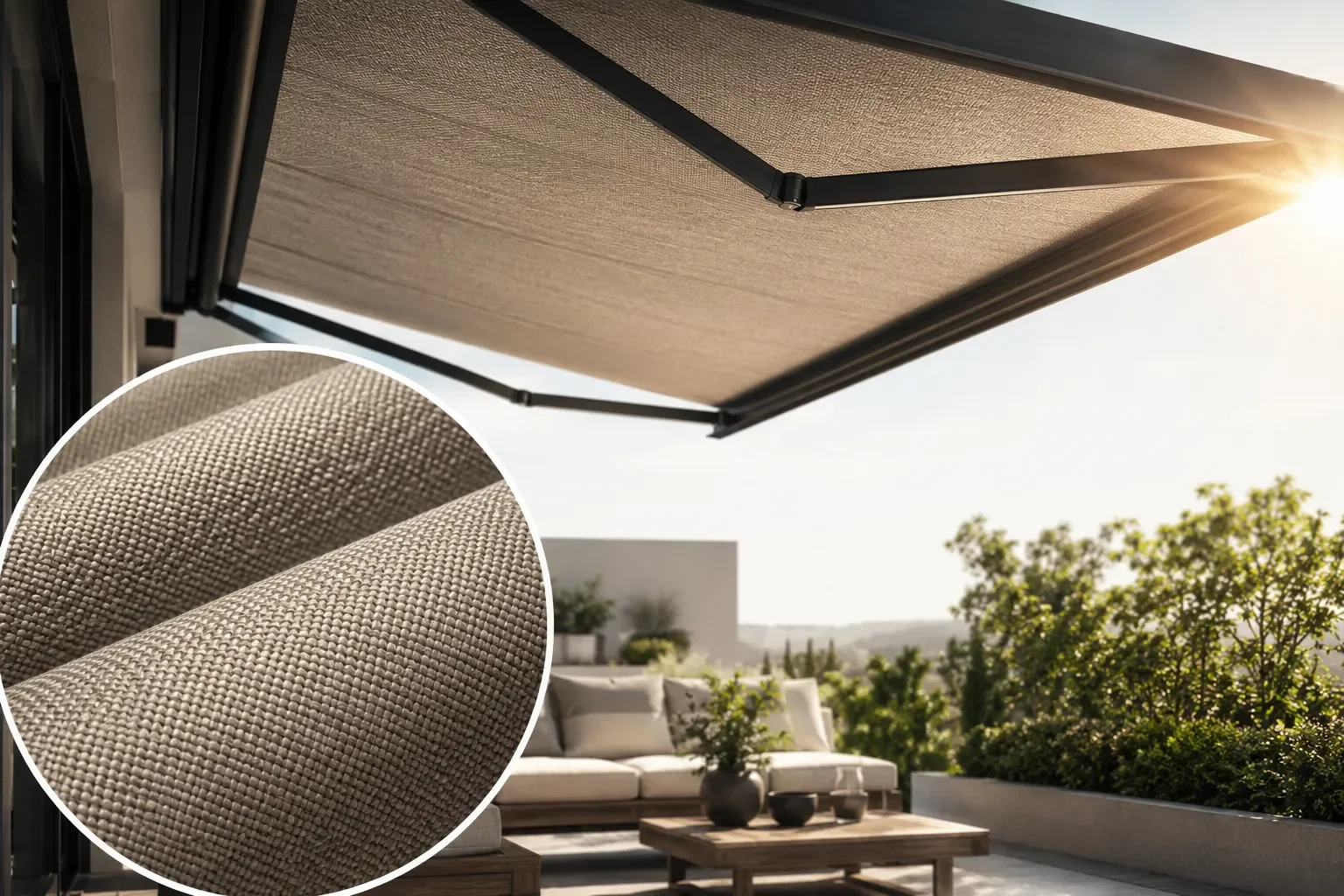
Awning cloth material is a high performance coated textile engineered to withstand prolonged outdoor exposure while providing solar control, rain protection, and structural integrity under wind load. It differs from standard decorative fabric in almost every measurable way: construction method, coating chemistry, dimensional stability, UV resistance, and fire behaviour.
The term covers a broad product family from traditional canvas awning fabric used in residential installations to precision-woven fiberglass and PVC-coated polyester textiles engineered for motorised architectural systems. Understanding which category of awning material is appropriate for a given application requires a clear-eyed evaluation of the environment, the system mechanics, and the performance objectives of the project.
The Main Types of Awning Fabric
1. Fiberglass-Core Awning Fabric
Fiberglass core awning cloth uses a woven glass fiber yarn as the structural backbone, coated with a PVC compound. This construction is the technically superior choice for large format, motorised, or precision-guided awning systems.
Why fiberglass outperforms other awning materials in demanding applications:
The glass fiber core has near zero thermal expansion it does not stretch or contract meaningfully as temperatures cycle between winter cold and summer heat. For zip-guided roller systems where the fabric must track accurately within a channel across spans of three metres or more, this dimensional stability is not a luxury it is a mechanical requirement. PVC coated polyester awning fabric, by contrast, will expand and contract measurably, which can cause tracking issues and premature edge wear in precision-guided systems.
Fiberglass awning cloth also maintains its flat, wrinkle free geometry across long roll lengths, which is critical when the fabric is deployed and retracted repeatedly in a motorised system.
Technical profile of fiberglass awning fabric:
Typical thickness: 0.70–0.75mm
Weight: 540–560 g/m²
UV blockage: ~97% across all colorways
Fire resistance: M1 (NF P92-503) and FR NFPA 701 dual certification for international commercial specification
Available widths: 250cm, 300cm, 320cm wide format to minimise seaming on large installations
Openness Factor: typically 5% for sunscreen variants; 0% for blackout
2. PVC-Coated Polyester Awning Fabric (PVC/Poly)
PVC-coated polyester awning material uses a woven polyester yarn base coated with PVC. This is the most widely used awning cloth in the roller blind manufacturing industry more flexible and easier to handle than fiberglass, with a softer drape that suits a wider range of system formats.
For patio awning fabric in residential or light commercial contexts, PVC/poly awning cloth offers an excellent balance of durability, solar control performance, and cost efficiency. It is also available in a broader range of textures and surface treatments.
The limitation of PVC/poly awning material relative to fiberglass becomes apparent at scale: in large format motorised systems, the polyester core's higher thermal expansion coefficient can compromise tracking precision over time. For smaller residential roller systems, this is generally not a concern.
3. Canvas Awning Fabric and Traditional Awnings Cloth
Traditional canvas awning fabric woven cotton or acrylic canvas remains in use for residential retractable awnings, café frontages, and heritage building applications where the aesthetic of canvas is part of the design requirement.
Canvas awning material is breathable and has a characteristic appearance that coated synthetics do not replicate. However, it requires more maintenance, has lower UV resistance without treatment, and is not suited to high-precision motorised systems. For commercial specifications where fire certification, dimensional stability, and long-term weathering performance are specified, technical synthetic awning cloth materials (fiberglass or PVC/poly) are the appropriate choice.
For canvas awning replacement projects where an existing canvas awning is being replaced with a modern fabric it is worth considering an upgrade to a technical awning cloth material, which will typically outperform the original canvas on every performance metric.
Key Performance Criteria for Outdoor Awning Fabric
UV Resistance and Colour Stability
Outdoor awning fabric is exposed to cumulative UV radiation that degrades both the PVC coating and the colour pigments within it. Quality awning cloth material uses UV stabilised PVC formulations that resist chalking, cracking, and colour fade. Testing against accelerated weathering standards (Xenon arc testing per EN ISO 105-B02 or equivalent) provides a quantitative basis for comparing long term colour stability between products.
A high quality outdoor awning fabric will retain its colour and structural integrity for 10+ years under normal European or equivalent UV exposure. Cheaper awning cloth materials with unstabilised PVC coatings may show visible degradation within 3–5 years.
Waterproofing
Awning fabric with a closed weave (zero or very low openness factor) provides effective rain protection water beads and runs off the PVC surface rather than penetrating the cloth. Open weave sunscreen awning fabrics, by contrast, allow water passage through the openness and are not waterproof in any meaningful sense.
For patio awning fabric applications where rain protection is a requirement alongside solar control, specify a low-openness or blackout-grade awning cloth material. For pure shade applications on pergolas or terraces where rain exposure is secondary, an open-weave sunscreen awning material may be appropriate.
Fire Classification
Any awning fabric used in a commercial, hospitality, or public building context must carry independent fire certification. The two most referenced standards internationally are:
M1 (NF P92-503): French standard, widely referenced across European specifications. Indicates the fabric is flame retardant and will self-extinguish when the ignition source is removed.
FR NFPA 701: US National Fire Protection Association standard. Required for commercial awning applications in North American markets and increasingly referenced in international hospitality and retail projects.
For any outdoor awning fabric going into a hotel, restaurant, retail environment, or commercial building, request the original test certificate not just a manufacturer's claim of compliance.
Dimensional Stability and Wind Load
Awning cloth material in large format systems is under constant mechanical stress tension from the system, wind induced flutter, and thermal cycling all work on the fabric over time. Dimensional stability under these conditions determines whether the system continues to operate correctly after years of deployment.
Fiberglass core awning fabric handles this environment with superior consistency. PVC/poly awning material performs well in residential scale systems where the mechanical demands are lower. Neither canvas awning fabric nor untreated synthetic textiles is appropriate for precision motorised systems with tight tracking tolerances.
Selecting Awning Material for Specific Applications
Motorised Zip Screen Awning Systems
Specify fiberglass-core awning cloth. The dimensional stability of the glass fiber core is essential for consistent zip channel tracking. Wide-format rolls (300–320cm) minimise seam requirements. Verify openness factor matches the solar control specification 5% is the most common commercial specification for sunscreen applications.
Retractable Patio Awning Fabric (Residential)
PVC/poly awning material is the practical choice for most residential retractable patio awning applications. It offers good UV resistance, effective rain protection at low openness factors, and manageable roll weight. For larger spans (over 4 metres) or premium specifications, consider fiberglass awning cloth for its superior dimensional stability.
Canvas Awning Replacement
When replacing existing canvas awning material, evaluate whether the original canvas awning fabric was performing to the building's current solar control, fire, or aesthetic requirements. A modern technical awning cloth fiberglass or PVC/poly will typically deliver:
Better UV blockage
Superior dimensional stability
Independent fire certification
Longer service life with less maintenance
The visual difference between a high-quality coated awning material and traditional awnings cloth has narrowed significantly matte finish PVC/poly products in particular can closely approximate the appearance of canvas awning fabric.
Commercial and Hospitality Facade Shading
For commercial facade applications hotels, offices, retail, healthcare specify fiberglass core outdoor awning fabric with dual M1 and NFPA 701 fire certification. Document solar performance data (TS, RS, AS, TV) per colorway for inclusion in the project specification. Wide-format rolls (up to 320cm) reduce installation complexity on large format systems.
How to Compare Awning Fabric Suppliers: The Right Questions
Commodity suppliers and technically credible awning cloth manufacturers produce products that look similar on a specification sheet but perform very differently over a 10 year service life. These questions separate them:
1. Can you provide solar performance data per colorway?
TS (Solar Transmittance), RS (Solar Reflectance), AS (Solar Absorption), and TV (Visual Transmittance) should be available per colour option not just per product line. Colour fundamentally changes thermal behaviour. If a supplier cannot provide per-colorway data, that is a signal about the depth of their technical documentation.
2. What fire certifications does the fabric carry, and can you provide the original test certificates?
Not a product datasheet the actual laboratory test certificate. For M1 and NFPA 701 compliance, the certificate should identify the specific product and batch tested, the test laboratory, and the test date. Certifications more than five years old on a current product warrant clarification.
3. What is the dimensional stability specification of the fabric?
For awning applications, ask for elongation data particularly thermal elongation under temperature cycling. For motorised zip-guided systems, this is essential data for system design.
4. What widths are available, and what is the minimum order quantity per roll?
For project procurement, roll width and pack length directly affect installation planning. Wide format fabrics (300–320cm) reduce or eliminate seaming requirements on large-format awning systems. Standard roll lengths are typically 30 metres for premium technical awning cloth.
5. What is the expected service life of the awning material under normal outdoor exposure?
A credible supplier will provide accelerated weathering test data or a stated performance expectation based on real-world installation history. If the answer is vague, ask for references or case studies.
Awning Fabric Technical Specification Table
| Parameter | Fiberglass Awning Cloth | PVC/Poly Awning Material | Canvas Awning Fabric |
|---|---|---|---|
| UV Blockage | ~97% | ~95–97% | 70–90% (varies) |
| Dimensional Stability | Excellent | Good | Fair |
| Fire Classification | M1 / NFPA 701 | M1 / NFPA 701 | Typically none |
| Available Widths | Up to 320cm | Up to 300cm | Typically <200cm |
| Waterproof (0% OF) | Yes | Yes | With treatment |
| Motorised System Suitability | High | Medium | Low |
| Service Life (outdoor) | 10+ years | 8–12 years | 5–8 years |
| Maintenance Requirement | Low | Low | Moderate |
TepText Awning Cloth Materials: Portfolio Overview
TepText supplies high-performance awning cloth materials for architectural shading systems, outdoor living applications, and commercial blind manufacturing. The product range is engineered for both indoor and outdoor applications, with full technical documentation and independent fire certification.
Fiberglass Sunscreen (Outdoor Awning Fabric): Glass-fiber core, PVC-coated construction. 5% openness factor. ~97% UV blockage. M1 NF P92-503 and FR NFPA 701 dual certification. Available in 250cm, 300cm, and 320cm widths. Full solar performance data (TS/RS/AS/TV) available per colorway. View product details here.
Fiberglass Blackout (Outdoor): Zero-openness fiberglass awning cloth for full rain and light exclusion. Suitable for motorised systems requiring total blackout and weather protection. View product details here.
PVC/Poly Sunscreen (Indoor & Light Outdoor): PVC-coated polyester awning material for residential and light commercial roller blind and retractable awning applications.
M32 / M36 Mesh Series: Open-weave outdoor awning fabric for pergola, terrace, and screen applications where higher openness and airflow are specified alongside shade. View product details here.
Frequently Asked Questions
What is the best durable fabric awning material for extreme weather conditions?
For extreme weather high UV, strong winds, heavy rain, significant temperature swings fiberglass core awning cloth is the most durable specification. The glass fiber core does not stretch or degrade under thermal cycling, the PVC coating resists UV induced chalking and cracking, and dual M1/NFPA 701 fire certification ensures compliance in demanding commercial environments. For residential patio awning applications in moderate climates, quality PVC/poly awning material performs very well at a lower specification cost.
What is the difference between awning cloth and awning canvas?
Awning canvas refers to traditional woven cotton or acrylic canvas used in retractable residential awnings. Awning cloth is a broader term that includes both traditional canvas and modern technical awning materials (fiberglass-core, PVC/poly). In commercial and architectural contexts, awning cloth material almost always refers to a coated synthetic technical textile, not traditional canvas.
Can I use indoor roller blind fabric as outdoor awning fabric?
No. Indoor fabrics are optimised for solar control through glazing not for direct weather exposure. They lack the UV stabilisation, waterproof coating integrity, and dimensional stability required for outdoor awning applications. Always specify fabric rated for the intended exposure environment.
What width of outdoor awning fabric is available for wide-span installations?
Premium fiberglass outdoor awning fabrics are available in widths of 250cm, 300cm, and 320cm. These wide formats are specifically designed to eliminate or minimise seaming on large format architectural awning and zip screen systems.
How do I find the right replacement awnings fabric for an existing system?
First, identify the openness factor and colorway of the existing awning cloth. Then match the mechanical specification particularly roll width and fabric thickness to ensure compatibility with the existing system hardware. If upgrading from canvas awning material to a technical awning cloth, verify that the new fabric's roll diameter and weight are compatible with the existing motor and cassette specification.
For technical consultation and project-specific fabric specification, contact TepText at info@teptext.com.
