

Exterior Mesh Fabric: Features, Benefits & Applications for Outdoor Shading Systems
Exterior mesh fabric occupies a distinct position in the outdoor shading textile category different from closed sunscreen fabric, different from blackout, and often misunderstood in terms of what it does and what it does not do.
Mesh shade fabric is engineered for applications where airflow, view through, and aesthetic integration with the outdoor environment are as important as solar control. It is the specification of choice for pergola shading, terrace screening, outdoor living structures, and commercial alfresco environments where the goal is not to seal a space from the elements but to modulate them — reducing glare and UV exposure while maintaining the feel of open air.
This guide covers exterior mesh fabric in technical depth: construction, performance metrics, application suitability, and how to select between different mesh specifications for a given project requirement.
What Is Exterior Mesh Fabric?
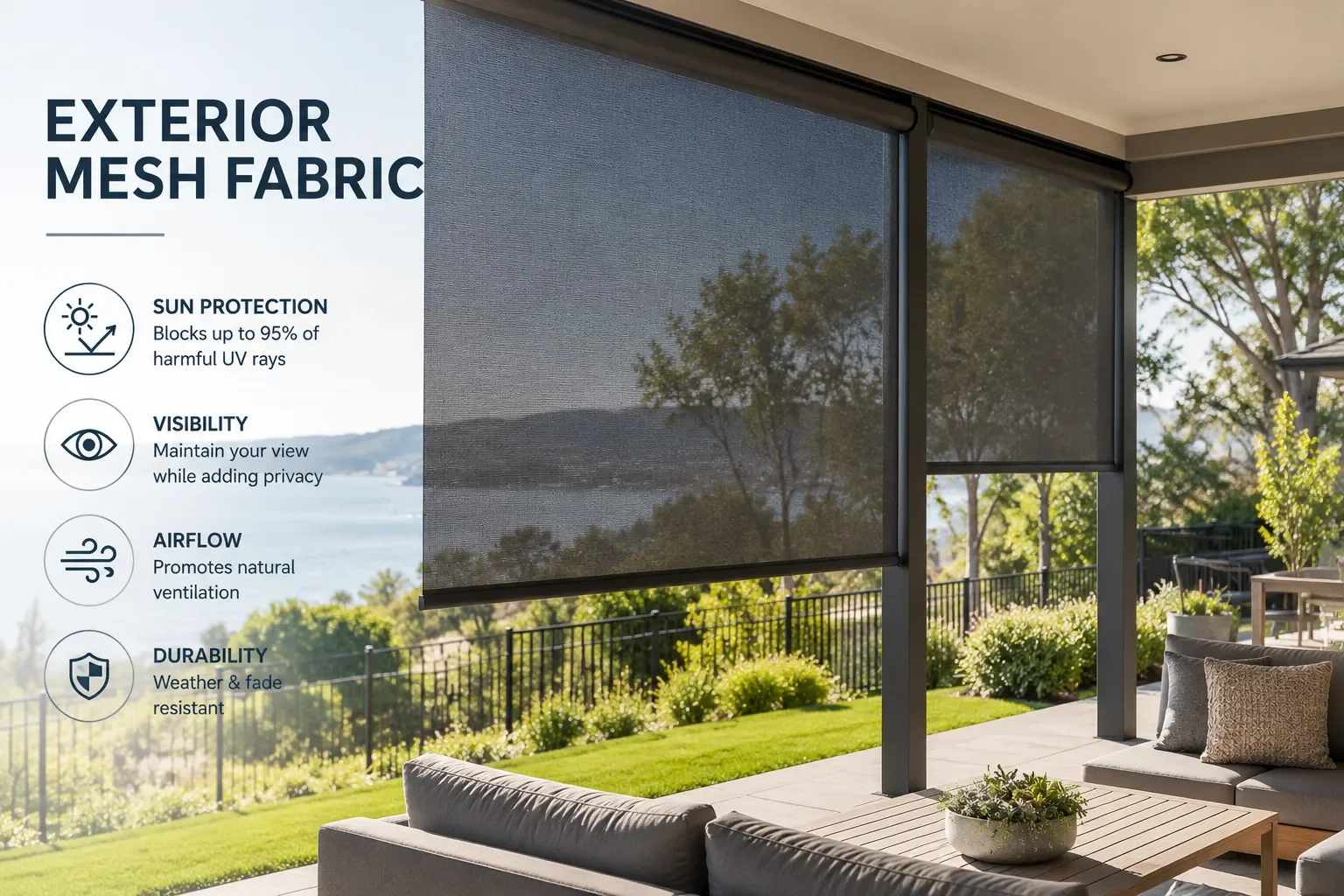
Exterior mesh fabric is an open weave coated textile engineered for outdoor shading and screening applications. Unlike roller blind sunscreen fabrics which are optimised for solar heat rejection through glazing in guided systems mesh shade fabrics are designed for free-hanging or lightly tensioned installations in open or semi-open structures.
The defining characteristic of mesh outdoor fabric is its higher openness factor: typically 10% or above, compared to the 1–10% range of standard architectural sunscreen fabrics. This higher openness delivers:
Better natural airflow through the fabric reducing heat build-up in covered outdoor spaces
Greater visual transparency and connection to the surrounding environment
Lighter weight and softer drape suited to pergola, canopy, and screen applications
Reduced wind resistance compared to closed sunscreen fabrics in the same application
The trade-off relative to closed sunscreen fabric is lower solar heat rejection and reduced privacy. For applications where these trade-offs align with the project objectives, exterior mesh fabric is the technically appropriate and aesthetically superior choice.
How Exterior Mesh Fabric Is Constructed
High quality outdoor mesh fabric uses UV-stabilised yarn typically PVC-coated glass fiber or PVC coated polyester woven into an open grid structure. The weave geometry determines the openness factor, the yarn composition determines UV and weathering resistance, and the PVC coating formulation determines long-term colour stability under outdoor exposure.
The yarn used in architectural exterior mesh fabric must be UV stabilised at the coating level not just on the surface. UV radiation degrades unstabilised PVC progressively from the surface inward, causing chalking, colour shift, and eventual yarn embrittlement. Quality mesh shade fabric uses PVC compounds with UV-absorbing additives that maintain performance across years of outdoor exposure.
TepText's M32 and M36 Mesh Series are constructed from UV stabilised coated yarn in an open-weave structure engineered specifically for outdoor shading and screening applications. The series designation (M32, M36) refers to the mesh geometry the yarn spacing and weave density that define each product's openness factor, weight, and performance profile.
M32 vs M36 Mesh Series: Understanding the Difference
TepText's mesh range offers two distinct constructions, each suited to different application requirements.
M32 Mesh Series
The M32 is a tighter mesh construction lower openness factor within the mesh range, higher yarn density per unit area. This delivers:
Greater solar control relative to M36 more yarn coverage means more UV and heat blocked
Better privacy screening the denser weave reduces view-through more effectively
Higher fabric weight per square metre relevant for wind load calculations in tensioned installations
Slightly reduced airflow relative to M36
M32 is the appropriate specification when: solar control and privacy are priorities alongside the open-air character of mesh fabric — for example, a commercial terrace that needs screening from adjacent buildings or street-level view-in, or a pergola on a south-facing elevation where direct sun management is a primary objective.
M36 Mesh Series
The M36 uses a more open construction higher openness factor, lower yarn density. This delivers:
Maximum airflow for covered outdoor structures
Highest visual transparency in the mesh range strongest connection to the exterior environment
Lower fabric weight suited to lightweight canopy and pergola installations
Reduced wind resistance an advantage in exposed locations
M36 is the appropriate specification when: the priority is air movement, transparency, and minimal visual obstruction a garden pergola where dappled shade and breeze are the design intent, a restaurant terrace where the view is a key part of the dining experience, or a lightweight shade structure where minimising wind load on the supporting frame is an engineering requirement.
Key Performance Characteristics of Exterior Mesh Fabric
UV Protection
Despite their higher openness, quality exterior mesh fabrics deliver meaningful UV protection through the UV-blocking properties of the coated yarn covering the closed portion of the weave. In practical terms, a mesh shade fabric with 15–20% openness is still blocking 80–85% of incident UV radiation through the coated yarn significantly more protection than no shade at all, and sufficient for most outdoor occupant comfort applications.
For applications requiring maximum UV protection medical advice against UV exposure, skin-sensitive occupants, or premium outdoor hospitality environments a lower-openness sunscreen fabric (5% OF) provides higher UV blockage than any mesh construction.
Airflow and Thermal Comfort
In covered outdoor structures, thermal comfort is determined not just by solar radiation control but by air temperature and movement. A closed sunscreen fabric over a pergola can trap warm air beneath the structure, creating an uncomfortably hot microclimate in still conditions. Exterior mesh fabric allows air to move freely through the structure, preventing heat build-up and maintaining the feeling of open-air ventilation even when solar radiation is being reduced.
For outdoor dining, residential pergolas, and leisure spaces where occupants are stationary for extended periods, the airflow characteristic of mesh shade fabric often delivers better experienced comfort than a lower-openness fabric with higher solar rejection.
Wind Load and Structural Considerations
Exterior mesh fabric installed over open structures experiences wind loading differently from fabric in guided systems. The open weave reduces wind resistance relative to closed fabrics, but mesh installations should still be designed with appropriate tensioning and anchoring to prevent fabric movement, flutter, and long-term mechanical fatigue at attachment points.
In exposed coastal or elevated locations, consult with the system designer or structural engineer on appropriate wind load assumptions for the specific mesh specification. Heavier yarns and tighter weaves (M32) generate more wind resistance than lighter open constructions (M36).
Weathering and Longevity
UV-stabilised exterior mesh fabric maintains its structural and aesthetic performance across multiple seasons of outdoor exposure provided the fabric construction uses quality PVC-coated yarn with embedded UV stabilisers. The enemy of long-term mesh fabric performance is UV-induced PVC degradation, which manifests as yarn stiffening, cracking, colour fade, and eventual structural failure.
Signs of quality UV stabilisation in exterior mesh fabric include:
Consistent colour across the fabric width and length after extended outdoor exposure
Flexible yarn that does not become brittle after one to two seasons
Maintained weave geometry no yarn migration or distortion under sustained tension
Supplier provided accelerated weathering test data (Xenon arc per EN ISO 105-B02 or equivalent)
Applications for Exterior Mesh Fabric
Residential Pergolas and Garden Structures
The most common application for outdoor mesh fabric in the residential market. A pergola with M36 mesh overhead provides dappled shade, UV reduction, and the aesthetic of a defined outdoor room without the closed-in feeling of a solid or low-openness cover. M32 is appropriate where direct sun management on a south or west facing pergola is more critical.
Installation is typically by tensioning the mesh between frame members, with peripheral lacing or clamping. For residential pergola applications, the fabric weight and ease of handling make DIY installation accessible in simple rectangular structures.
Commercial Terraces and Alfresco Dining
Restaurant, café, and hotel terrace environments benefit from exterior mesh fabric shading in several ways: UV and glare reduction for seated diners, maintained outward view and the ability to define the space visually without enclosing it physically.
For commercial applications, fire classification is required. Verify that the mesh fabric carries M1 or equivalent certification and that test documentation is available for building compliance purposes.
Outdoor Screen and Privacy Applications
Exterior mesh fabric used vertically as a screen panel for terrace privacy, pool enclosure, or facade screening provides visual separation while maintaining ventilation. The view-through characteristics of mesh fabric depend on the light differential: in daylight, a person inside a mesh-screened space sees through the fabric more clearly than someone outside looking in, providing privacy without total visual barrier.
For privacy screen applications where view-in from outside must be effectively eliminated in all light conditions, a lower-openness sunscreen fabric (5% OF) will outperform mesh mesh provides partial rather than effective privacy screening.
Commercial Building Facade Shading
Architectural mesh fabric is used in some facade applications particularly secondary skin installations and external louvred or tensioned facade systems where free air movement between the mesh layer and the building envelope is part of the thermal strategy. This is a specialist application requiring structural and thermal engineering input alongside fabric specification.
For standard facade solar shading through glazing, roller blind sunscreen fabric (fiberglass or PVC/poly, 5% OF) is the more appropriate specification than exterior mesh. Mesh fabrics are better suited to open-air applications than to precision-guided roller systems.
Exterior Mesh Fabric vs Sunscreen Fabric: When to Use Each
| Criterion | Exterior Mesh Fabric | Sunscreen Fabric (5% OF) |
|---|---|---|
| Primary application | Open outdoor structures | Glazed facades, guided systems |
| Openness factor | 10%+ | 1–10% |
| Airflow | High | Low |
| Solar heat rejection | Moderate | High |
| UV blockage | Moderate (~80–85%) | High (~97%) |
| Privacy | Partial | High (daytime) |
| Rain protection | None | None (open weave) |
| Motorised zip system | Not suitable | Suitable (fiberglass) |
| Pergola application | Preferred | Possible but over-specified |
| Fire certification | Required for commercial | Required for commercial |
| Weight | Lower | Higher |
TepText M32 and M36 Mesh Series
TepText's M32 and M36 Mesh Series are engineered for outdoor shading, screening, and pergola applications. Both series use UV-stabilised coated yarn woven into open-grid constructions optimised for outdoor performance.
M32 Mesh Series: Higher yarn density within the mesh range. Better solar control and privacy screening relative to M36. Suitable for south and west-facing installations where direct sun management is a priority alongside open-air character. → teptext.com/outdoor-fabrics/m32meshseries
M36 Mesh Series: More open construction. Maximum airflow and visual transparency. Preferred for residential pergolas, garden structures, and commercial terraces where connection to the exterior environment is a primary design objective. → teptext.com/outdoor-fabrics/m36meshseries
For technical data sheets, sample requests, or application-specific consultation, contact TepText at info@teptext.com.
Frequently Asked Questions
What is the difference between exterior mesh fabric and sunscreen fabric?
Exterior mesh fabric has a higher openness factor, better airflow, and is designed for open outdoor structures like pergolas and terraces. Sunscreen fabric operates at lower openness, provides higher solar heat rejection and UV blockage, and is designed for guided roller blind and facade shading systems. They solve different problems and are not interchangeable in most applications.
Is exterior mesh fabric waterproof?
No open weave mesh fabric allows water to pass through the open areas of the weave. Mesh shade fabric is a solar and UV control product, not a rain protection product. For covered outdoor spaces requiring rain protection, a closed sunscreen or blackout fabric at low openness factor is the appropriate specification.
Can exterior mesh fabric be used in a motorised roller blind system?
Mesh fabrics are generally not suitable for precision zip-guided motorised systems the open construction does not interact well with zip channels, and the higher openness and lower tension characteristics of mesh fabric do not suit the mechanical requirements of guided roller systems. For motorised outdoor systems, fiberglass sunscreen or blackout fabric is the appropriate specification.
How do I choose between M32 and M36 mesh?
Choose M32 when solar control and privacy are priorities alongside open-air character. Choose M36 when maximum airflow, visual transparency, and lightweight installation are the primary objectives. Both series are appropriate for outdoor residential and commercial applications the choice depends on the balance of performance objectives for the specific project.
How long does exterior mesh fabric last outdoors?
Quality UV stabilised exterior mesh fabric maintains its performance and appearance for 5–10 years under normal outdoor exposure conditions. The key variable is UV stabilisation quality in the PVC coating cheaper mesh fabrics without proper UV stabilisers may show significant degradation within 2–3 seasons. Ask for weathering test data or a stated expected service life from any mesh fabric supplier.
